On Facebook? I can see your private messages UPDATED: No I can’t.

But it’s probably worth hiding those old posts anyway…

———————–  UPDATE ———————–

So it’s looking like these posts weren’t Private Messages after all. Back in the old days of Facebook, say between 2007 and 2009, the layout was quite different and, instead of sending each other messages and having to deal with Timelines et al, we used to have the option to write wall-to-wall.

We weren’t all as social-media-savvy back then and believe it or not, your Mum, your boss and all your co-workers weren’t as up to speed either…

Hence the openness of all those wall posts. Major panic subsiding, minor panic still worth cleaning up…

———————————————-

This is happening right now…

Here’s a grab I took before hiding the relevant issues.

The best possible fix is to hit the SETTINGS icon at the top right and hit ‘HIDE FROM WALL’

So far, TechCrunch have picked it up with others following.

If you don’t want people to see your private messages on Facebook, do this now.


Google bought Wildfire: Mind. Blown.

For $250m apparently. The mind boggles…

WF G

So what does this actually mean?

And why is it such a big deal?!

Well, as I explained to some friends earlier:

“They – Wildfire – are a preferred developer for Facebook and have probably built every amazing branded Facebook app you’ve ever used or heard of. Google BUYING them not only gives the big G access to a whole host of Facebook data, but is also a HUGE strategical move that is just mind-blowing in its scale and ambition. 

Google just walked into Facebook’s yard, picked up their ball, players and goals, and casually walked back home.”

Gaining preferred developer status is no easy task and Wildfire have been knocking out big brand Facebook apps/games/sweepstakes now for a good four years. Since March 2012 in fact, Wildfire have been the (self-proclaimed) ‘biggest social marketing company in the world’.

In 2011, Wildfire saw revenue growth of over 300% and surpassed a total of 13,000 paying customers, including 30 of the top 50 global brands. This makes us the largest social media marketing software company in the world.

Our platform has been used to power over 200,000 marketing campaigns throughout the world. Going global required some expansion, though, so we’ve grown our team to over 300 employees (from 2 in 2008). We put offices in London, Paris, Munich, and Singapore, which helped grow our international business by 500%, and now more than 24% of Wildfire’s revenue comes from outside the U.S.

That’s some impressive work.

I’ve seen presentations from Wildfire: everything from Polaroid and Lady Gaga to Virgin Atlantic and Vodka, there’s hardly any major brand out there that hasn’t been touched by these guys. Seriously, their customer list is immense.

And, try as they might to reposition themselves as a ‘social marketing company’, Wildfire are (or were) a Facebook company.

And now they’re owned by Google.

I’ll say it again:

And now they’re owned by Google.

— —

My immediate instinct is to yell: HOLY HELL! FACEBOOK ARE GOING TO PISSED!

But then I think more…

I think about how Wildfire also have deep YouTube integration, and I think about the cool stuff they’re doing (or were doing) with LinkedIn and Twitter too.

And you know what I do then?

I think about Google+

What does Google+ need more than anything right now?

  1. Big brands
  2. Big brand promotions
  3. Big brand promotions that deliver user engagement

Y’see, no matter what the numbers say, Google+ just doesn’t cut it right now. Not for brands, not for users, not for anyone. Wildfire can bring all those folks to the party, and more.

Don’t count on Wildfire (as we know it at least) to burn for much longer though, I mean it’s not like Google have a history of killing off a whole bunch of products – right?

Right.


Google just bought Wildfire.

Mind. Blown.


Nike, Twitter, and the ASA: new rules are required

A fifteen minute lunchtime download

Guardian Headline

It happened.

If you missed this in the press, Nike had their Twitter campaign banned because they were found to be in breach of the ASA’s online remit around transparency.

The ASA said –

“We considered that the Nike reference was not prominent and could be missed. We considered there was nothing obvious in the tweets to indicate they were Nike marketing communications.

In the absence of such an indication, for example #ad, we considered the tweets were not obviously identifiable as Nike marketing communications and therefore concluded they breached the [advertising] code. The ads must no longer appear. We told Nike to ensure that its advertising was obviously identifiable as such”.

You can read the full and thorough article over on The Guardian, however (and if you’ve already done that), for me, this finding throws up a whole other set of questions that I first started pondering nearly a year ago.

In this IAB post ‘Rules Rules Rules‘, from August 2011, five months after the ASA remit extension – I made the following argument:

————–

“If we … think about the combined worlds of brand, celebrity and sport personality, for example – how do these new standards play out?

Case in point: Tiger Woods and Nike.

When we see Mr Woods teeing up at the PGA Tour, do we question that the Nike cap he chooses to wear is there for any other reason than advertising? No. Of course not. It’s an expectation. Something that we, as the viewing public, have grown to accept within this particular industry. It’s a given that this happens. However, it’s also assumed that – given his high profile nature – that this sponsorship must have happened. Why else would he be wearing the logo? And of course, there is no doubt that Nike put out a press release when this sponsorship was made – but how long ago was that? Tapping the word ‘ad’ on the tail of everything [paid for] that we publish is kind of silly really.”

————–

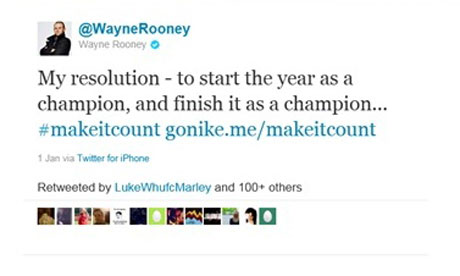
Swap Tiger Woods for Wayne Rooney and we’re pretty much in line with what has happened here.

While I, as a social media practitioner and professional, wholly endorse legislation to correctly monitor and police this nascent marketing channel, I find it hard to not at least side slightly with Nike with their defence of:

‘…both players were well-known for being sponsored by the retailer which argued that Twitter “followers” would not be misled about the relationship it had with the players.’

The ASA’s sticking point?

‘It was understood from its investigation that the final content of the tweets was “agreed with the help of a member of the Nike marketing team“.’

It’s important to acknowledge this key point: Nike had a say in what was written by their sponsored sportsman. If they didn’t, then it wouldn’t be an issue, (right?).

Placing that aside

Everything that’s been written about social media has defined how different it is from the rest of the media types that have come before it; it changes the game.

The Snickers case [item 5], was found to be not in breach of the new remit. Nike, was. To say this is still very much a grey area would be an understatement and, as a result, the industry needs smarter, more fluid, regulations accordingly.

While HONESTY will always be your best marketing tool (thank you, Nicole), when one side thinks it was being true and the other thinks it wasn’t, an adult conversation needs to be had about consumer-wide understanding and acceptance of what sponsorship means.

And moreover, just how exactly celebrity sponsorship works together with social media.


How this blog stays alive

The content, obviously comes from me. The framing, the clean-theme and overall niceness that the content is framed within, that came from Pepsmedia.

However, there is a third part of the equation that doesn’t get much airtime or love…  and that is of the hosting, the ‘backend’ …the admin if you will.

And that just so happens to be one Mr Nicholas Butler.

Future of Online Video @ ICA #amp09

via Phil Campbell

Nik, also known as Loudmouthman, has been looking after the backend of this wordpress site ever since it first fumbled it’s way into the world four years or so ago. Before he came along, I was posting my mad mutterings onto a VOX blog and, believe it or not, before that, even MySpace. Yeah, I know.

But, ever since I bought my very own URL, Nik has been looking after my backend. What this means is: when I first set up, he did all the annoying bits. And, when my site is down, I get to ask him (normally via Twitter), if it is for him too. When the answer is yes, it is back up again within minutes. MINUTES.

I don’t know how it works and I don’t know how he does it.  What I do know is – for example, this past the weekend, on Sunday in fact, I wasn’t able to actually publish anything and, within 30mins of emailing Nik, the problem was fixed.

This is nothing short of awesome.

What I’m trying to say is: if you’re doing anything that involves IT, admin, web-backendy things, wordpress, hosting, security, load-testing etc…  Generally all that other stuff that you don’t really want to think about, EVER; be you big business, or tiny start-up, SPEAK TO NIK BUTLER.

I whole-heartedly recommend (and use) his services.

Loudmouthman - well it wasn't broken when I left it :)

via Benjamin Ellis

And I’m not alone either, Sizemore is a fan and, if you’re still not sold, go read the comments on this blog post Nik wrote about giving ‘lasting advice’.

Epic.

Nik Butler. This site wouldn’t be here without him.


“Fish where the fish are”

It’s a wonderful phrase.

You hear it often in this here industry of ours: it’s a ‘quick win’, an ‘obvious’ way forward – you do a spot of audience analysis, find out where people are talking [about you] and then go and make them buy stuff, right? Simple.

Except, it’s not that easy.

There’s more to it than that.
Much more.

First you need to make sure you’ve got the right equipment: is the line strong enough for the fish you’re aiming to hook? Have you got the right bait? Have you brought enough bait? Scratch that, do you even need bait? Perhaps a spinner will work in its place? What hooks will you use?

Hell, have you even organised a boat?

Once you’ve got your kit sorted, then you need to hone your technique: how do you cast? How long should you wait? What do you do when you get a bite? Do you reel in immediately or take your time and let the fish come to you? Again, all things that you need to consider.

Like any good fishing trip, you need time and you need patience. You’re not going to catch Jaws overnight (you might, there is such a thing as beginner’s luck). But know how long you’re going out for and know what fish you’re trying to catch and, crucially, how many fish you need to catch to put a smile on your face.

Moreover, why are you here? Are you fishing for game, or for your supper? How dependent are you on this next catch? If I give you a fish now, would that be OK? Or would you rather work at it and catch it yourself, later?

Remember, in nearly all instances, chance favours the prepared mind and fishing where the fish are is all well and good as long as you know how.

Be prepared.

Go fish.


Current attempts at television-based social media integration are failing, hard.

How do we fix them?

To find the solution, we first need to fully understand the problem.

2screen / dual-screen / second-screen — all are different names for the kind of integration that I’m referring to and it’s something I’ve been kicking around in my head ever since I went to my first 2screen event back in October 2010.

It was a big deal then and it’s a bigger deal now.

With the increase of iPad penetration and the continuous growth of the smartphone market, the notion of 2screening is becoming more and more commonplace. In fact, a recent Neilsen survey found that 80% of tablet and 78% of smartphone owners used their device while watching TV at least once during a 30 day period.

In the app-world, services such as ZeeBox and Sky Sports for iPad are doing very good things indeed. Both integrating news, stats and social media streams into your second screen; providing a suitable data-based accompaniment to your visual consumption.

However, I want to talk about television-based social media integration (not app-based).
This kind of stuff –

http://content.screencast.com/users/whatleydude/folders/Jing/media/742fdfb4-9a02-4998-91c7-e8508e1b8b6a/jingswfplayer.swf

That’s how Sky One’s ‘Got to Dance‘ handles it and many other broadcasters follow suit. BBC One is getting in on the act too, here using a Twitter wall backstage for the UK edition of ‘The Voice‘.

Twitterwall

What do these examples all have in common?

Fundamentally, they are all bringing (or at least attempting to bring) the conversation from the second screen, to the first. Which, correct me if I’m wrong, kind of defeats the object of the second screen.

Whether it’s reading out tweets during the credits of Celebrity Juice on ITV2 or talking about Facebook wall posts inbetween programmes on BBC3, broadcasters seem to be obsessed with sharing (read ‘owning’) viewer social media.

Recognising that conversation takes place away from their platform(s), TV + social media work best together when television directs its audience to the conversation medium, as opposed to smashing them in the face with it via another.

Sorority Girls, an E4 TV show, flashes up their hashtag both at the start and at the end of their show as well as when going into ad breaks.

This is good! This is television saying –

‘Hey, perhaps some people are actually watching our shows when they’re on and, instead of going to the kettle during an ad break, they’re turning to Twitter!’

– and giving the audience a your hashtag at this point is a very good idea. You own it, you guide it, you track it.

Ignoring The Voice for a second, the BBC actually do this quite well, both with Question Time and Have I Got News For You, for example:

via Roo Reynolds

Little pointers like this give you, the viewer, the option of tracking (and joining) the back-channel. If you understand what it means, you join the conversation. Perfect.

I guess this is one big plea to broadcasters to just stop reading out tweets and Facebook updates on the telly. Seriously, it just doesn’t work.

Finally, and returning to the opening image of this post, the new trailer for Prometheus aired recently during the first break of Homeland. Channel 4’s own announcer was employed also, asking viewers to tweet their reactions using the hashtag #areyouseeingthis.

So far, so good. Right? Right.

Except that, 20mins later (during the next ad break), those very tweets were displayed onscreen for all to see.

via Digital Examples

Yes that’s actually a TV ad you’re seeing there, with (clearly moderated) tweets displaying instead of your usual commercial break. Mental.

Reports state that this activity reached a potential audience of 15m users. (Note: POTENTIAL audience. That’s the number of every tweet with the hashtag, multiplied by their sum of their followers – ie: not a real number). And while this kind of exercise is a great advert for Twitter, it leaves existing fans and users feeling a bit… empty.

In closing, encouraging viewers to join an online conversation is one thing, replaying that conversation to them 20mins later is just a pain in the oculars.

Discuss.


Is Play.com breaking Facebook TOS?

To be honest, I’m not sure. Take a look at this

@playcomakaplay.com

Facebook Timeline for brands is brand new and as such, the nuances and intricacies of the new user interface are still being worked out*. However, a good place to start when dealing with a new service structure is the service supplier themselves. In this instance, that’s Facebook.

Their [new] terms of service (specifically to the cover photo) state:

__________________________________

All covers are public. This means that anyone who visits your Page will be able to see your cover. Covers can’t be deceptive, misleading, or infringe on anyone else’s copyright. You may not encourage people to upload your cover to their personal timelines.
Covers may not include:

  1. Price or purchase information, such as “40% off” or “Download it on socialmusic.com”;
  2. Contact information such as a website address, email, mailing address, or information that should go in your Page’s “About” section;
  3. References to Facebook features or actions, such as “Like” or “Share” or an arrow pointing from the cover photo to any of these features; or
  4. Calls to action, such as “Get it now” or “Tell your friends.”

__________________________________

I interpret that asOi! No special offers on your cover photo!‘ 

2012-04-10-21-50-34_DC3834B8-9CA6-4E2E-9FB6-C71F965AC246

…but I could be wrong.

Being unsure (and in constant search of a decent debate), I asked Twitter

Ask Twitter

The crowd certainly think so – although, funnily enough, Play didn’t respond.

Covers including special offers certainly seem off limits from the Facebook’s terms of service and, in all honesty, that’s what I’ve been advising friends, colleagues and clients when it comes to embracing Facebook’s new Timeline layout…

Either way, Play are sailing pretty close to the wind. Wouldn’t you say?
Friends, readers and peers – what do you think?

Better yet, why don’t we ask Play?


*for example: knowing how many characters you should use in your ‘about’ section.


Instagram + Facebook

I had a post scheduled for later on this week talking about my recent love affair with all things Instagram (even though I don’t actually own an iPhone) however, some news is breaking right now that kinda needs covering.

Facebook just bought Instagram, for $1bn.

That’s right: One. Billion. Dollars.

Stefan nailed it –

Well, do you? It’s a lot.
But why?

To start us off, here are some numbers* to get your head around taken from the mere 18mths that Instagram has been in existence:

  • 1 billion photos uploaded
  • 30 million registered users
  • 5 million photos uploaded every day
  • 575 likes every second
  • 81 comments every second
  • 1 million downloads of the new Android app in 24hrs

That’s a lotta love for an app that is solely mobile-based. But why is that important to Facebook? Think about it – Facebook is about the data. As the saying goes: if you’re not paying for the product, you are the product – and Instagram just sold a whole ton of data about its users. Not personal data, or contact data but image data and sharing data.

What people snap, what filters they apply when they’ve snapped and where & how they share that snap is all important data for a social network that builds itself around social objects and the relationships that people form around them.

While this kind of purchase is new ground for Facebook, it’s refreshing to see that it has every intention of keeping the service independent and multi-platform friendly. Mark Zuckerberg has already talked about lending Instagram Facebook’s strong engineering team and infrastructure – something that they’ll need when it comes to the building for scale. That sounds like someone who only has the app’s best interests at heart, certainly.

And while a billion dollars is a lot of money, Facebook has just bought itself its own standalone photo-sharing app, with a built-in base of happy users while at the same time cancelling out a potential competitor in the lucrative social networking space. Good things will come of this acquisition, Yahoo + Flickr this ain’t.

As Instagram CEO, Kevin Systrom, blogged earlier today

It’s important to be clear that Instagram is not going away. We’ll be working with Facebook to evolve Instagram and build the network. We’ll continue to add new features to the product and find new ways to create a better mobile photos experience.

Remember, the future is mobile and Instagram have proven that a mobile-only social network is not only worthwhile but 100% achievable to boot.

Best of luck guys (all 13 of you); your fans, users, industry and investors will be watching.

*since April 3rd, 2012 – source

UPDATE – Other posts of note:

Like Minds: the five word of mouth moments of 2011

Last October I was fortunate enough to be asked to speak at the fantastic Exeter-based conference, Like Minds.

Like Minds 2011 Day 3

— pic via the extremely talented Harry Duns

My topic? The five word of mouth moments of 2011.

Easy, right?

You don’t need me to tell you the first five that spring to mind, so let’s look what happens when you probe a little deeper –

[your comments and feedback, as ever, are welcome]

Oh, and the best thing? I just managed to lay my hands on a ticket to the rather exciting TEDxObserver 2012.

Speakers include one Miss Camila Vellejo.

Amazing.


The Hunt for Hanna

Just over a week ago I was sent an email about the new Blu-Ray/DVD release of the child/assassin-based thriller, Hanna.

Note: this is not your average email, but we’ll come to that shortly.

If you’ve not seen the film before (I haven’t), it’s about a teenage girl (the amazing Saoirse Ronan) who has been trained by her ex-CIA father (Eric Bana) to basically be a complete bad-ass. Think Hit-Girl from Kick-Ass [but slightly older and with less pink wig-ness] and you’re probably halfway there.

Anyway, like I said, she’s been trained to be THE PERFECT ASSASSIN and then well, from what I can see from the trailer, Cate Blanchett turns up and the proverbial really hits the fan.

Speaking of which, the trailer is worth a look –

What do you think? I missed this at the cinema as I had only just got back from my mad trip across Siberia, but it does actually look quite good. IMDb gives it a solid 7/10 and, I think I probably will pick this up at some point also.

So, why am I blogging about it? Given that a) I haven’t actually seen it yet and b) although the film looks good, it doesn’t seem to be the kind of epic masterpiece that normally drives me to put e-pen to e-paper.

Well, it’s that email I mentioned at the top. It would seem that HMV and Universal have teamed up to create a rather awesome Foursquare-based treasure hunt across three major cities in the UK (London, Birmingham and Manchester) that kicks off this weekend.

Based around the central themes of the film, each hunt contains six codes that need cracking and from there you end up with six locations that need checking into.

The prize for completing said task? Er.. a weekend in Berlin! Sweet.

If you’re any of the above cities, your orders are available c/o The Galinka Project (but be quick, you only have until Monday). In the meantime, I have codes to crack.

Catch you later.