How to opt-out of auto-play videos in Facebook

If you hadn’t heard, Auto-play ads videos in the Facebook mobile app (and desktop) are on their way.

Facebook Videos - DEATH

Good? Bad? Annoying? All three? Yeah, maybe. But look, here’s the bad news: on mobile, you can’t actually switch them off. What you can do however is prevent them from playing over your mobile network. In other words, make the videos only download over Wi-Fi only, and ostensibly opt-out of letting them auto-play on your handset.

Here’s how that works.

  • On iOS
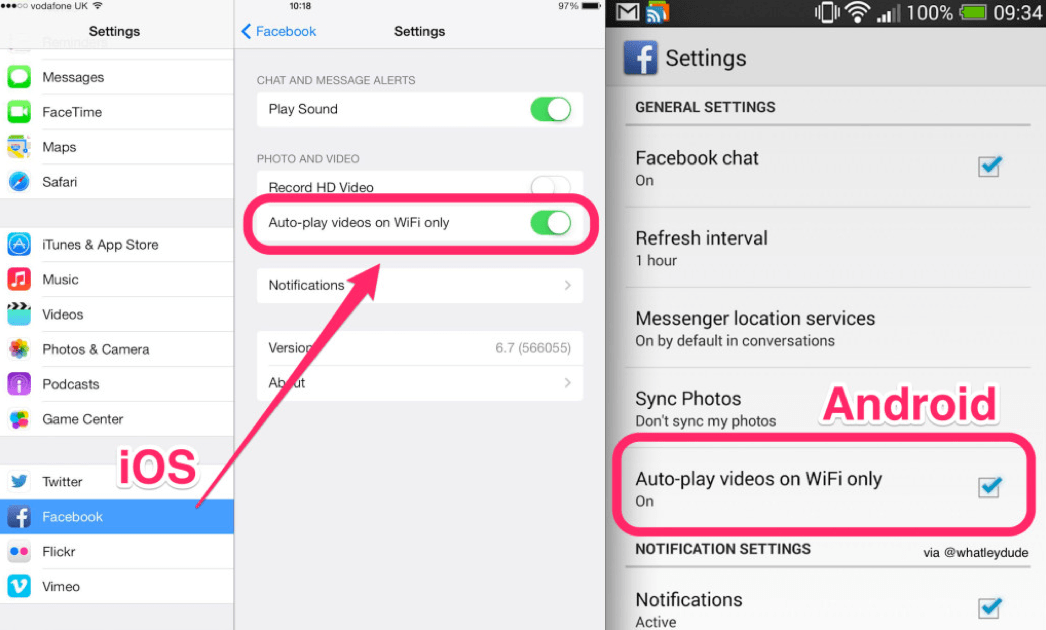
    Go to Settings -> Facebook -> Facebook Settings -> ‘Auto-Play videos on WiFi only’
  • On Android
    Go to Facebook -> swipe right to the options pane -> App Settings -> ‘Auto-play videos on WiFi only’

Switch off auto-play videos in Facebook mobile

The benefits of this are two fold:

  1. If you’re hardly ever connected to wi-fi, you can pretty much ‘opt out’ of this auto-play media completely.
  2. If you’re not on any kind of unlimited data plan with your network provider, this will prevent Facebook eating into that precious data.


Hat tip to he who spotted this, Charles Arthur.
Go give him a follow.


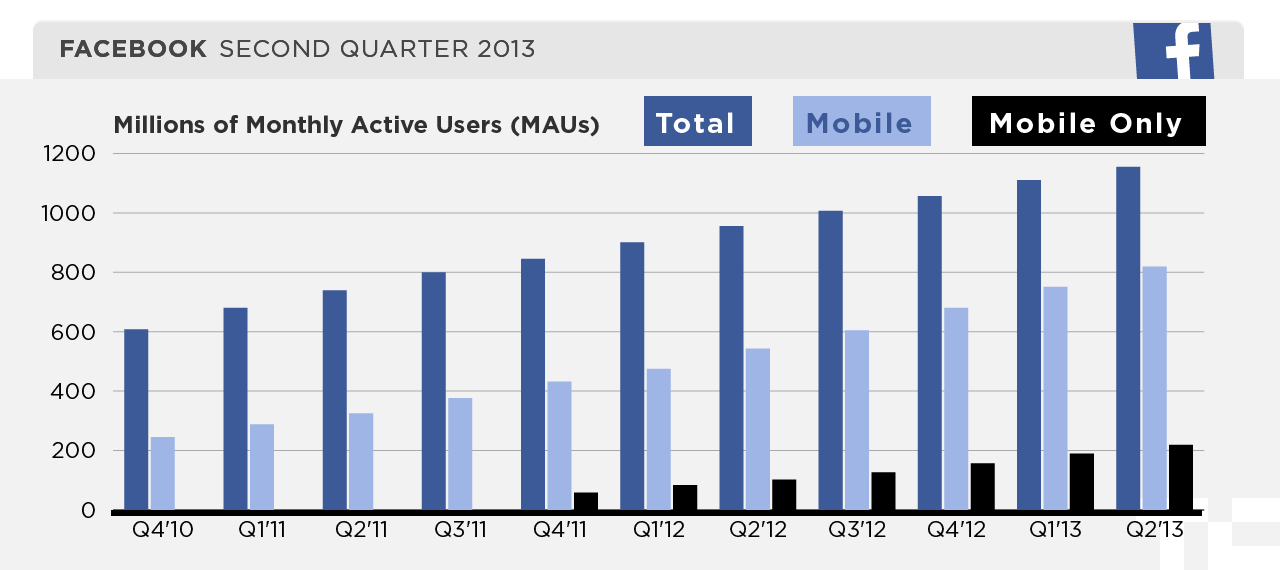
83% of Facebook’s UK Daily Users are on Mobile

How many?

Facebook MAU DAU

Source: TechCrunch

According to the above chart, posted yesterday on TechCrunch, Facebook’s Daily Active Users (DAU) for mobile make up a staggering 83% of all active users.

First off, that’s a MASSIVE NUMBER.

Second, we need to dig a little deeper. As Josh Constine states ‘To be clear, total stats count each individual user as 1 regardless of whether they accessed from desktop, mobile, or both. Mobile stats count each user who accessed via mobile, whether or not they also accessed via desktop.’

What this means is that while they’re not exclusively accessing Facebook via mobile*, 83% of overall DAU do at some point access via mobile. That is still a huge number.

What does this mean?

  1. Surprise surprise, UK users access Facebook from their mobile phones
  2. If you’re a brand using Facebook to speak to your users (y’know, through building apps and stuff) you better be thinking MOBILE FIRST – but again, this is not news
  3. A genuinely surprising amount of new openness from Facebook means that we should be seeing more data like this in the future.

Hurrah and hurrah again.

I’m also left wondering, why on Earth wasn’t this picked up by more trades?

Whatley out.


PS. Reading this on your mobile? Best check Facebook…

PPS. Contrary to popular opinion, this isn’t ‘the first time’ Facebook have admitted this algorithm exists. They did that back in 2010. 

*To get the exclusive number, you’d need Facebook to release a deep dive on this image. But they haven’t done that yet. So we wait.


One of these things is not like the others

Can you tell?


Wayne Rooney (@WayneRooney) April 12, 2013


Wayne Rooney (@WayneRooney) March 30, 2013


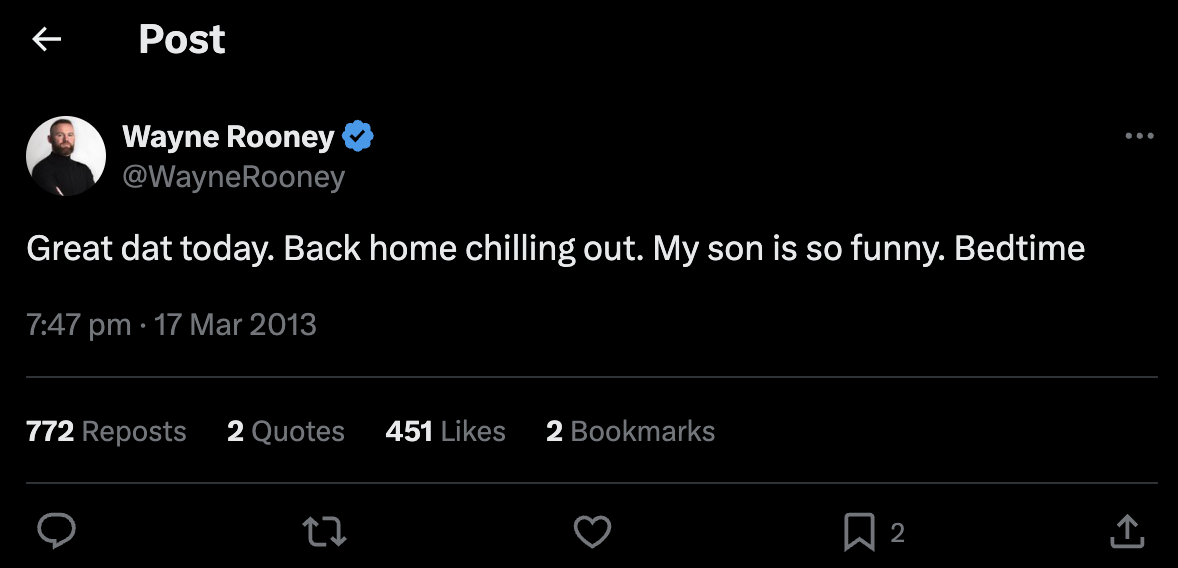
Wayne Rooney (@WayneRooney) March 17, 2013


Wayne Rooney (@WayneRooney) April 7, 2013

Any ideas? Anyone?

No, I’m not sure either. In the meantime, I’ll just leave this here:

Example: a Twitter user is paid by a brand owner or marketing practitioner specifically to use Twitter to promote a brand, product or service. The brand owner or marketing practitioner should ensure that the Twitter user discloses the payment by including #ad within their tweet. As tweets are limited to 140 characters, the use of the #ad hashtag allows maximum room for the message itself, but also makes clear to consumers that the message has been paid for.

Nope, I can't work it out either


Cheers.

H/T Andrew Allsop.

I wonder what the ASA will make of it.

Update: Sad times.

Ads on Instagram are already here. But are they legal?

Place your bets now please…

The facts:

  • The Facebook-owned photo-sharing site, Instagram, does not have a business model (yet).
  • ‘Official’ ads will be coming soon (if on hold), but celebrities (and their sponsors) aren’t waiting around.
  • The US Federal Trade Commission state that ads on social media must be labelled as such*.

With those key points in tow, let’s take a look at a few recent examples of how ads have begun to appear on the this particular social network –

EXAMPLE 1:  Lebron James, Nike

Copy: ‘These are simply the best!! Ultra comfy and can wear them with anything. I’m ordering 100 pair right now. #kicks #Nike #family’

Is this an ad? It could be deemed as such, certainly. Is Lebron James sponsored by Nike? Definitely. Is ‘endorsement of product across social media’ part of his contract? Maybe. This is something I’ve talked about before. In short: how do social media advertising rules work when it comes to sponsorship deals? Should this image have an #ad tag?

Let me know in the comments.

EXAMPLE 2. Kim Kardashian, Sun Kissed

Copy: ‘Sprayed tonight after watching KKTM! My legs are soooo dark! Loving Kardashian SunKissed! #AvailableAtUlta’

If this isn’t an ad, then I really don’t know what is. Let’s review –

  1. We’ve got a CLEAR product shot!
  2. We’ve got a a massive ENDORSEMENT (Kim’s ‘LOVING’ it guys).
  3. Finally, that final hashtag? Oh, hi there call to action. How you doin’?

All of these elements add up to a clear piece of advertising. Is it marked up as such? No. While you could argue that KK is endorsing her own products here (so no money has officially changed hands, and this is technically not actually ‘paid for’ advertising) and therefore she’s exempt from the advertising guidelines… but still, it’s a grey area at best.

EXAMPLE 3: Nicole Richie, Suave
(image via Ad Age)

Copy: ‘Ad: My new don’t-leave-home-without-it product? Moroccan Infusion Styling Oil from @SuaveBeauty! Check out ways to add brilliant shine to your style here: bit.ly/XDJOkp’

OK, so this works. Finally someone is using the ‘Ad’ tag properly when it comes to advertising via earned media – hurrah! The interesting point here is that the brand in question has gone on record and said that the above image was indeed part of the existing partnership between the company and Ms Richie. Again, making things even clearer. Perfect.

——  So what can we learn from this?

There are three things at play here –

1. Without a business model, Instagram, and therefore Facebook, is clearly missing out on potentially lucrative ad dollars being bought and sold on their network.

2. Celebrities, and their sponsors, are getting smarter, faster.

3. In the same way that the ASA took Snickers and Nike to tribunal here in the UK, I wouldn’t be surprised if the FTC went knocking on the doors of a few US-based brands in the very near future.

It sounds so obvious when you say it out loud but, when it comes to paid-for endorsements on social media, clarity and transparency are key.


*Here in the UK, the ASA have a similar policy but the terms regarding disclosures are not as explicit.

NEW Twitter Cards for Brands: The Impact

Twitter has quietly launched new markup documentation for twitter cards…

And brands should take note. Why? Let’s start at the top –

What are Twitter cards?

Twitter cards are a fairly recent addition to the Twitter suite of tools that allow richest media content (images, videos, and blog post previews – or ‘photo’, ‘player’, and ‘summary’ respectively) to be displayed in-stream. Launched last year with a few partners such as The New York Times and WWE, these expanded Tweets are another way for publishers to engage with Twitters in a more meaningful way.

Since June last year, Twitter has slowly released this functionality both as new partnerships with other media houses; and as developer documentation for others to add to their own websites and blogs.

Why are they useful?

It’s simple: Twitter cards enable a preview (or in some cases a full view) of the content linked to in the Tweet. This means users of the official Twitter client can consume content without leaving the app and, if they do have to click out, they have a better understanding of what they’re about to engage with.

So what’s new?

Overnight, Twitter launched three more variations of the Twitter card on top of their ex: App, Gallery, and Product.

The first two work as follows –

App
This one shows information about an app; including the app name, icon, description and other details such as the rating or price. If your app is in the AppleApp Store or Google Play, then the corresponding information there can be pulled in accordingly.

Result? More app downloads, hurrah! 

Gallery
This new card represents an album or a collection of photographs via a preview of the photo gallery. This card indicates to a Twitter user that a gallery has been shared, as opposed to just one individual photo.

Result? More imagery = more engaging = increased CTR.

That’s all well and good, but it’s this next third one that I find most interesting:

Product
The Twitter product card can represent different products by showing an image and description, along with up to two customisable fields that let you display more details like price or ratings.

On both web and mobile, it would look something like this –

Result? MORE. SALES. It’s that simple. 

In short: this is fantastic.

This basically says that brands can now, with a simple piece of html markup, preview actual products, for purchase, including reviews and/or pricing information into their followers’ Twitter streams. Combine that with some decent tracking and you finally have what looks like a decent social sales ecosystem.

Think about that for a second; instead of ‘Hey! Look at this thing we’ve launched! [link]’, you now get ‘Hey! Look at this thing we’ve launched [image] + [price]’.

HUGE.

We’re already talking to our clients about getting this markup integrated into their websites’ product pages, and we’ve got a funny feeling a few of you might be too.

Exciting times indeed.


The FTC: Paying for a Tweet? It needs fine print.

Just over a week ago now, the Federal Trade Commission (FTC) in the US ruled that ads in Twitter (or paid for/sponsored Tweets) need to follow the same basic requirements as the rest of the advertising world, eg: they need some fine print.

To prevent consumers being misled by their favourite celebrity, for example, sponsored social media must now be sure to include an explanation of sorts that explains that the content in question is paid for.

There are two kinds of responses to this ruling:

Response 1  (the dumb response):

“Oh my God?! Are you guys NUTS?! SMALL PRINT?! ON A TWEET?! WHAT? Does the FTC have any ideas as to what they’re talking about?! We’ve only got 140 characters to work with here! COME. ON!”

The FTC clearly state ‘Disclosures must be clear enough that they aren’t “misleading a significant minority of reasonable consumers. If a company can’t find a way to make its disclosure fit the constraints of social or mobile ad, it needs to change the ad copy so that it doesn’t require a disclosure.’

So we move on –

Response 2 (the smart response): 

“Oh, you mean sticking ‘#ad’ on the end of paid-for content? Yeah, sure. We can do that. In fact it makes sense and hell, it’s only three characters; that actually helps us!”

What’s great about this ruling is that they’ve been very clear about what does and what does not constitute ‘full disclosure’ and – to my mind at least – settles a long-standing argument over what is the best way to signal a Tweet is an ad.

Here in the UK both #spon and #ad are accepted or ‘recommended’ ways to indicate that the social media content you’re consuming is paid for. It’s something that I personally disagree with; #spon is too esoteric and doesn’t actually mean anything to the every day Twitter user. #Ad not only makes it clear what it is you’re looking at but it also uses less characters too. The FTC are in agreement:

‘Consumers might not understand that “#spon” means that the message was sponsored by an advertiser. If a significant proportion of reasonable viewers would not, then the ad would be deceptive.’

In short, when paying for tweets: #ad good, #spon bad. 

The full PDF from the FTC is available to download and, aside from being essential reading to every US-based social media practitioner, is actually a really insightful read and well recommended for anyone looking for a basic understanding of what is and what is not possible when it comes to the world of paid-for social media content.

I would especially recommend taking a look at ‘Example 17’ in the appendix to firmly understand the nuances involved when dealing with celebrity endorsements.


Five key takeaways from Social Media World Forum 2013 #SMWF

Looking for ways to get social media traction at your place of work? Read on –

This past week, the 2013 European Social Media World Forum (#SMWF) conference took place in London and yours truly was lucky enough to not only attend, but also appear on one of the panels.

More on that last part shortly but first, my remit for the event was simple:

How did I get on? That remains to be seen, but here are five key takeaways that are definitely worth paying attention to.

1. Zero budget does not mean zero spend.

‘We got our social media up running internally with zero budget!’
‘Social media was a cost-free way to get our message out!’
‘We had no extra budget from our stakeholders, yet we still managed to get it launched!’ 

These statements are all fundamentally not true.

All meaningful efforts in social media need that most valuable of any company asset: hours. Without time, none of it would happen and without effort, none of it would happen properly. This seems like an obvious statement but you’d be surprised how many times it is said, heard, and believed within corporate circles. Next time someone tells you social media is cheap and easy, tell them: you’re wrong!

2. ‘If it doesn’t work on mobile, go home!’

The above statement was said by Dominic Burch (pictured above), head of social media for UK supermarket chain, Asda (part of the Wal-Mart group). This is huge. Why is this huge? Asda’s target market is Mums.

Back in 2010, Google Chief Exec Eric Schmidt took to the stage at Mobile World Congress and said his new motto was ‘mobile first‘.  Three years later and big corporations are catching on. Not only to this future-proofing concept, but also to the fact that their audiences have moved. Mums are mobile first, which means you have to be too.

Also: 56 RTs and counting.

3. Pirate Ships work.

Many of the speakers at #SMWF spoke today about ‘working outside of the rules’ and ‘circumnavigating process’; this is typical pirate ship behaviour. What am I talking about? Let me explain.

Back in days of old, pirates were able to out-manoeuvre large naval ships by being low in number, agile in their approach, and surprisingly daring in their gold-gaining strategies. Many social media teams started out in the exact same way. The lead social media head spots the opportunity to make revenue, breaks away from the pack, shoots, scores; and then – and this is key – begins to recruit more pirates to his/her cause (additional takeaway: if you can’t find another pirate internally, ‘network your face off’ within the business – Nissan’s head of social did this for years until he had the support he needed to launch the dept. formally).

From global finance companies, through to every day supermarkets – the pirate ship methodology works. If they can do it, you can too.

4. Know what you are, but also know what you’re not.

Cordell Lawrence from Jack Daniel’s gave a superb presentation in their ‘Telling, not Selling‘ session on what and how authenticity drives their social media output. All of their efforts stem from a clear brand ethos and strategy that informs everything they do both above the line and below the line, throughout social media.

The key take out (for me at least) was the ‘What Jack is’ and ‘What Jack is not’ slide. This is textbook brand strategy; strong brands know what they are, but stronger brands know what they are not. e.g.:

  • Jack is traditional.
  • Jack is not trendy.
  • Jack is whiskey as a craft.
  • Jack is not whiskey as a product.
  • Jack is friendly.
  • Jack is not silly or cute.

I’m from a branding background and seeing this kind of strategy warms the cockles of my heart. On top of that, and coming from an experienced community management perspective, these kind of guidelines are essential for delivering an on brand and on target social media tone of voice.

5. Help others to help yourself.

This last one really does read like some kind of meaningless platitude that wouldn’t go a miss out of a nursery book at bedtime. HOWEVER. When it comes to selling social media usage upwards in the chain of command, this could never be more true.

To provide context, and please forgive me – this really isn’t rocket science, the question and answer ran as follows:

Q: ‘How do I convince my manager that we need to use social media?’

A: Simple. Find out what their objectives are; find out what their KPIs are; find out exactly what that person needs to do to do in order to attain their bonus at the end of the year and then show them how social media can help them achieve those goals.’

You’d be amazed at what making your boss look good in front of his boss will do for your efforts in social.


Facebook Hashtags. Wait, what?

That’s right: According to sources, Hashtags are coming to Facebook.

YEAH?

AND?

WHY IS THIS IMPORTANT? 

I’ll tell you –

1. Ownership
Let’s get one thing clear: Hashtags are not owned by Twitter. They’re used heavily throughout the platform, of course they are, they help track conversation topics. In fact, Twitter is so entrenched in the hashtag that they’ve now taken to describing themselves as ‘The shortest distance between you and what interests you’.

The ‘you’ in that equation is the @name. The ‘what interests you’ part of it? The hashtag. Hashtags really are great for connecting users to the information that they’re looking (on Twitter at least). You know what else they’re good for?  Ad sales. But we’ll come back to that one…

Hashtags are used across other (mostly lesser known) social networks but when your average consumer sees them today, it’s fair to say they immediately associate them with Twitter.

Not for much longer.

Ps. Y’know where else Hashtags are used? Instagram. And you remember who owns Instagram, right? Right. 

2. Graph Search
With the advent of Facebook Graph Search, Facebook really needs to start to getting to grips with meaningful conversation data. What do I mean by that? On a panel recently about Facebook’s latest search product, one of the issues that we discussed was the potentially huge disparity between the two elements of data that will be mined via Graph Search; behavioural and surrendered.

I might Like something, but that might just be to gain access to an app or a game or whatever. That’s behavioural and that’s sketchy at best. Surrendered is even worse; Facebook is trusting its users to enter their personal information fully and honestly – this simply does not happen.  These two issues combined do not an accurate search engine make.

However.

Using hashtags to badge up Facebook posts suddenly creates anchors within user conversations. First, these anchors are searchable and second, you can sell ads against them.

‘Oh hey Twitter, nice ad model you got there. We’ll take it. ‘

You get the idea.

3. Discovery  
Last month, Dan Rose, VP of Partnerships at Facebook, made it very clear that television and the second screen was definitely an area that Facebook was going to move in to. Perhaps not immediately, but soon.

Being able to tag your Facebook post against say, the TV show that you’re watching? That’ll be one major step towards that paradigm.

Earlier this week I wrote about what Twitter’s new Ad API meant for social media ad-planning. With Facebook now introducing (their own version of?) the hashtag, this same model applies: choose your TV show, pick your audience, choose your time slot, go buy ads…

OK, so obviously this won’t happen overnight; Facebook has a billion users and it needs to shepherd them in slowly, v-e-r-y  s-l-o-w-l-y…

But with the new News Feed inbound, Facebook hashtags (and their ads) could soon be just but a click away…


Google Reader is shutting down on July 1st, 2013

Planning on updating this post as new GReader options start to appear and I get to play with each of them according.

This is not a drill.
(last updated 20:10, March 14th).

Goodbye GReader

AGAIN: Google is closing down Google Reader on July 1st.

Take a moment to process that… then read on.

Marketing Land, where I first read the news (before The Verge got it up, before Techcrunch nailed it too), is building up a list of replacements (all of which I am yet to try). So far they have:

Other notables are

Edit 1: LifeHacker has a good transfer guide too. 

Edit 2: Feedly is swiftly becoming the new Reader of choice. Here’s why:

‘Google announced today that they will be shutting down Google Reader. This is something we have been expecting for some time: We have been working on a project called Normandy which is a feedly clone of the Google Reader API – running on Google App Engine. When Google Reader shuts down, feedly will seamlessly transition to the Normandy back end. So if you are a Google Reader user and using feedly, you are covered: the transition will be seamless.’

Thanks to GigaOm and JMac (comments) for the tip.

Edit 3: RussB’s Magnet.io is now open for sign ups

Outside of those, go follow Russell Beattie. He’s been working on a Google Reader replacement for a while – aka Magnet.io – and if we all go give him our support, it might just make it out before Google hit the shutdown button.

Edit 4: Former Google Reader Product Manager, Brian Shih, explains what he thinks what happened over on Quora

I’m just sad. So sad. Google Reader is where I get my news. It’s where I find my random. It’s what drove my Five things on Friday last year, and it’s what drives my weekend link blasts over Twitter.

It sounds dramatic but, I genuinely am distraught. Anyone who knows my blogging habits knows that I am a news hound. I search for the new, the unknown, the esoteric.. and I share it. Google Reader has been my weapon of choice for as long as I can remember and now, quite literally, its days are numbered.

No good can come of this.

 — – – 

Right now, I don’t know which service to switch to. To be perfectly honest a lot of it will depend on whether a) the next platform can take the weird-ass download file Google gave me, and b) if Reeder App will support it too.

Google Reader was great. Then it was good. Soon it will be gone. 

For now, we mourn. 


Targeting Twitter’s audience by the TV that they watch

The future, I sees it –

Back in September last year, I put together a few ideas about what evolutions we might see in the social media industry during 2013. Snappily entitled ‘2013 Social Media Predictions‘, one of the areas focused on was how Social TV and advertising would need to work closer together if they planned to meaningfully speak to their audiences across multiple different platforms.

Quote:

“…Soon smart media-planners will force Twitter to allow time-sensitive promoted tweets, with time-focused twitter ads designed to populate at specific times – down to the very minute. Whereas the traditional consumer used to put the kettle on, today’s viewers are now turning to Twitter (and away from the ads), the industry won’t put up with this for long.”

Makes sense, right? Of course it does. So it came as no surprise at all to read that, thanks to the advent of Twitter’s new Ad API, the smart folk at TBG Digital have done just that.

Introducing Calendar Live, a new platform that  allows buyers to purchase Promoted Tweets in sync with television programmes. It’s that simple. While it’s true that marketers could kind of do this already, this new system makes it supremely easier and brings in additional features such as trend monitoring and more granular time-targeting.

Calendar Live

Bonus simplicity: it looks just like your TV guide – 

While this isn’t the kind of ad-based scheduling I was initially talking about, it is a step towards a more connected approach to social media ad-planning. Good work Twitter, and well done TBG. We’ve been looking at a number of solutions to manage our approach to social media and TV of late, and Calendar Live looks like it might actually have something useful to both brands and agencies alike.

Three final points:

  1. With similar fantastic work taking place right now in the form of Three’s #DancePonyDance, this kind of integration really is the at the forefront of where social media, and thus social TV, is headed during 2013.
     –
  2. SXSW is on right now which, to me at least, means big news like this gets swept away under the mess of it all. Rule one: don’t launch during SXSW.
     –
  3. I love it when I’m right.
    -Â