An idea for London

Why not set up Oyster card touch points at each busking semi-circle which could give £1 per tap?

Apple Pay arrived in the UK this month – woo!

apple-pay-cards

And, teething issues aside…

//platform.twitter.com/widgets.js

…the launch has only served to further enlighten the public at large that we are indeed edging ever closer to a completely cashless London.

For some, that’s awesome.
For others, it’s a problem.

Specifically, it’s a problem for the buskers of the London Underground.

For those of you that don’t know, the buskers of our fair city’s amazing transport system are all auditioned and then licensed accordingly; they are of a standard.

With 39 busking pitches across 25 stations with an audience of up to 3.5m commuters every day, these talented guys and girls have a huge opportunity to turn in a few quid by pleasing the ears of the frequent passers by.

That is, if they carried a few quid on them.

Which, as we’ve established, is becoming rarer and rarer.

chart

Source.

SO HERE’S A FREE IDEA:

Why not set up Oyster card touch points at each TfL busking pitch that could give £1 per tap?

Think about it.

I’m pretty sure the technology wouldn’t need that much of an update to allow for this adjustment. You could start in Zone 1 and work out, or vice-versa, and go from there.

It should be simple from a logistical perspective as well. For example, given the already acknowledged stringent licensing that takes place, it follows that the talented musicians that grace the tunnels beneath our streets would probably have to book into their respective slots in advance. Meaning there must be a database somewhere that tracks who plays where and when.

Simply marry that data up with the money tapped in during those hours, and at the end of each day (or at the start of the next), said talent collect their money from a TfL window or a collection point of some description.

From a cost angle, TfL/Oyster could lift 1% of the donation to cover costs or if they were really savvy, they could get a brand to partner up on it and they could pay the costs as part of the sponsortship.

That’d make sense wouldn’t it?

What about safety? TfL handles millions of commuters every day and those tunnels and walkways have to be kept clear BUT if there’s room for a girl with a cello, there’s certainly room for a wall-hugging Oyster ‘tap-to-donate’ button.

Right? Right.

In short, it frustrates me when I hear great music and/or singing and am unable to show my appreciation because of the lack of shrapnel about my person. With a busking Oystercard touch point, I’d be able to give a pound every time I liked some music.

Which would be ace!

With the advent of Apply Pay, contactless payments in London have never had greater mindshare. If we truly give a monkey’s about our city then we should be working hard at lowering the barriers to donating to charity wherever possible and fundamentally making it even easier to move towards the progressive-yet-caring cashless society we’re so ardently idealistic about (maybe that last past is just me).

Try this: next time you’re in the Underground and you hear a busker that you enjoy, I want you to think about how much would it please you if you could just tap-to-donate them a pound as you wander by.

If TfL made it happen it would be:

  • An extra bit of pocket money for TfL.
  • A potential not insignificant lift in busker-income.
  • A way of helping the commuters of London feel better about having the cashless pockets that society is granting upon them.

So come on TfL, let’s make it happen.

——-

(not from TfL? Click this to let them know)


Pebble: 14mths later

Something happened recently. Something in my year-long self-experiment with wearables that I did not expect.

Discovering an invisible benefit form the long term usage of wearable tech.

Pebble choices

With all the Apple Watch news of late, it has never been easier to file all smartwatch content away under the umbrella term of ‘wearable tech’.

//platform.twitter.com/widgets.js

The man has a point.

Thing is: all Pebbles are wearables, not all wearables are Pebbles.

When I wrote up my ‘Pebble: two weeks later’ thoughts back in January of last year,  I said:

Almost like a mini personal assistant, it fields incoming alerts from my phone so I don’t have to. I choose when I pick my phone up, not the other way around; reminding me that the phone is there for MY convenience NOT everyone else’s.

And that has remained true.

“Yes but”, my friends said in unison “all you’ve done is replace one addiction for another. Instead of looking at your phone every ten minutes, you’re forever checking your watch instead!” –  they had a point.

And I didn’t ignore them.

At the turn of the year, I started experimenting with switching the Pebble to ‘phone calls only’ mode as in, ‘please only buzz and alert me to incoming phone calls, those people that need to talk to me right now‘. In the six weeks I’ve been back from SXSW, I’d say that my Pebble has been on Phone Calls Only mode around 90% of the time.

The thin layer that Pebble has placed between my phone and I has thickened and now I no longer have the fear when I haven’t checked, seen, or even been near my phone for anything longer than seven minutes.

I thank Pebble for that.

That’s not to say that I no longer enjoy the benefits that Pebble brings. I can still browse and view the ongoing notifications, I just choose to opt-in to them instead. By that I mean, I scroll to the ‘notifications’ section in the watch and click through/dismiss/reply as and when I remember. It’s a good system.

It’s funny. I guess in the same way that nicotine patches help ween smokers from their addiction, Pebble has taken the form of a mild intervention; helping me simultaneously both remember and realise that my phone is there for my convenience, and not everyone else’s.

As I type this now, my phone is to my side, face down, and on silent. My Pebble is in on Phone Calls Only™ and I haven’t looked at my phone for nearly 300 words. When was the last time you could say the same thing?

These days I find myself ignoring my email inbox for hours, sometimes days. It’s just not important enough. SMSs? I’ll reply when I can. It might be now, it might be in an hour. But it’ll be when I want to, not when my watch told me I should. That change is powerful.

Some of you might read this and think ‘Yeah, I was right all along – wearables are not for me!’ but I don’t think you can genuinely form an opinion on their benefits (short and long term) without trying them for yourself. This recent shift hasn’t changed my opinion of wearable tech – in fact it’s only served to make it more positive. I’ve backed Pebble’s next iteration of the watch (Pebble Time Steel – if you fancy Googling it) on Kickstarter and I’m really looking forward to the next layer of benefits that’ll bring to my life.

My smartwatch helped me crack my smartphone addiction and my life is better for it. Which I guess makes Pebble the equivalent of mobile phone nicotine patch, who knew?

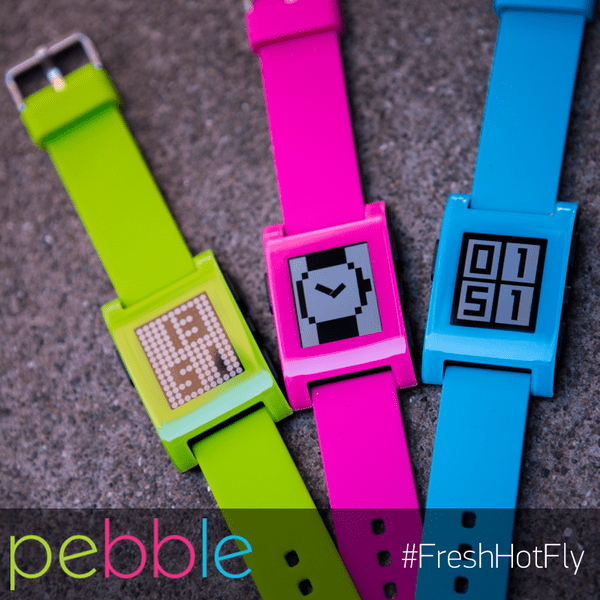
Get Pebble: #FreshHotFly

I don’t think Pebble is specifically targeting women with this new range, they’re simply for people who happen to like pink.

Woo! New Pebbles!

noopebbles

I have a Pebble watch (I think it’s GREAT, by the way). These new colours, firmly aimed at the youth market, are pretty darn awesome. Although it has to be said, the first thing I thought when I saw them was:

“You KNOW that someone at Nokia just binned their designs for some kind of 2015 Microsoft Lumia smartwatch, right? Eep!”

Because that’s what they look like!

Lumia Pebble

Joking aside, they actually really do match brilliantly with a multitude of Lumia devices which, to me at least, seems like a great idea. Lumias might not be the number one selling mobile device in the world, but the trend of fluorescent hardware is something that’s been around for at least a couple of years now and these new Pebbles are actually really quite awesome. Good job, gang.

One thing I didn’t pick up from either the website or the launch video (below) is that any part of it was ‘cutesy’ or that it was specifically targeted to women.

It’s a cool [smart]watch.

A unisex one at that.

So how do you get from that, to this?

//platform.twitter.com/widgets.js

I don’t think ‘cutesy’ equals women. Nor do I think that the new range (or the page linked) is in any way female only. So I’m confused. I DM’d Belinda earlier asking for clarification but am yet to hear back (and will of course update should I hear anything). I asked my friends to see what they think, and they seem to agree: the colours are on trend and, if they’re marketed at anyone, they’re marketed at ‘the kids’.

Just because ‘hot [pink]’ is used, it doesn’t mean its necessarily marketed to women. In fact, from about 59 seconds in the video above, the pink watch is clearly shown on a man.

I don’t think Pebble is specifically targeting women with this new range, they’re simply for people who happen to like pink.

Available now.

__

EDIT: a couple of people have asked why I didn’t engage directly on Twitter about this. Truth be told: I’m actually off Twitter at the moment and only checked in this morning for a work-based thing (this just happened to the first thing I saw).

Celebrating 100 Episodes

Of our mobile news podcast, The Voicemail.

Stefan & James, together on Episode 60

Back in May 2012, Stefan Constantinescu and I were in search of someone to podcast with.

//platform.twitter.com/widgets.js

Thanks to a sharp-eyed friend (thanks Michael) we were connected over this mutual need and committed to not only doing a podcast, but doing it properly. Organised over Twitter at first, Stefan and I bought the right kit and then, less than two weeks later, sat down and recorded our first episode of The Voicemail.

The Voicemail 001

Our first episode was just a bit of history about our mutual interests in mobile but from episode two onwards we decided we’d cover that week’s latest mobile news and cast our eyes over what was hot (and what was not) in the industry that we’re both so passionate about.

We’re an opinionated pair at times – ahem – and don’t always agree however that combination turned out to be quite popular and now, some two years later and now with over 1000 listeners every week (!!!), we’re still going strong.

This morning Stefan and I recorded our 100th episode.

It shouldn’t be that much of a big deal, it should be ‘just another episode’ and in many ways it was. However it’d be unfair to get this far without pausing to reflect upon the brilliant support we’ve had along the way.

So this post is a big fat THANK YOU to everyone that’s listened, commented, tweeted, facebook’d, blogged, chatted, gossiped, even mentioned us in passing to a fellow geeky friend – your positive word of mouth has helped us grow and grow and grow. It’s amazing to know we have your continued support. Thank you.

A second THANK YOU goes to the numerous guests we’ve had along the way. Stefan and I don’t have many rules on the show but one of them is that we only ever have two of us on. If one of us can’t make it, then it’s the other’s responsibility to get a replacement. Which was fine right up until Stefan went travelling for four months and we had a new guest every single week. You know who you are and we appreciated every single one of you.

Finally, the last big fat THANK YOU goes to my Podcasting partner in crime, Stefan Constantinescu. Having a project buddy who can ensure you stay committed (and vice versa) is a really valuable thing. Not only is Stefan super knowledgeable in all things mobile, he’s also been there every week [nearly] without fail. Simply put: the show wouldn’t happen without him.

Episode 100 is now live [here’s the direct download link for the MP3, 30MB], this week we covered the LG G3, Apple [finally] buying Beats by Dre, and Google’s self-driving cars.

If you’ve never listened to us before, why not check us out and subscribe today?

You can find us on our website, on iTunes, or copy and past this RSS feed into your podcast app of choice and just go from there.

Here’s to the next 100 episodes!

Review: Nokia Lumia 1520

Can you guess how this turns out?

About a month ago, those kind ladies and gents at Nokia Connects sent yours truly a loaner Nokia Lumia 1520 to review. I quite like that they did as, thanks to a ridiculous SIM card issue, I’d previously implied that didn’t really want one [to review].

I can count on one hand the amount of devices that require the uber-tiny and utterly ridiculous nano SIM (why one of the biggest phones known to man needs to have a smaller SIM card than say, I don’t know, the Galaxy S4 Mini, I’ve no idea but still) and I don’t own one of them.

I’m not about to go chopping up my existing SIM card (micro, like most people) and then have to use an adaptor for the rest of my mobile life either. The net result was that I had Lumia 1520 to review that I couldn’t actually use as a phone.

Perhaps sending me the device was an attempt at winning me over. On first impressions, this humongous phone very nearly did.

There is no denying it: the Lumia 1520 is gorgeous. The matte black colour that my device came in only further exaggerates the smooth contours of the design and it is a delight to hold. Throughout the three week trial period, I actually caught myself either just staring at it or on occasion, just stroking its smooth soft finish.

Read into that what you will but as soon as you have a 1520 in your hand, you’ll know exactly what I mean.

Something else you’ll notice when you have a 1520 in your hand: you might need more than one hand: this phone is massive.

That’s a full-size 3rd gen iPad on the right, by the way. Not an iPad mini.

I’m not a huge fan of the half phone/half tablet, or ‘Phablet’ (blergh), form factor. My podcast colleague, Stefan Constantinescu, swears by them but I remain unconvinced.

What I will say is however is that, after a particularly long afternoon where all I used the 1520 for was gaming (the 6″ screen is fantastic and Temple Run 2 was a particular highlight), going back to my not-exactly-small HTC One seemed weird.

Sticking with the hardware aspects of the device it almost goes without saying with flagship Nokia devices: the camera on the 1520 is excellent.

I’ve used it to take myriad photos. Several of which made it into my Empty Underground project – having a kick-ass camera for this made me very happy indeed. Also, the feature set of the camera is pretty darn good too.

Very. Cool. Feature. Indeed.

And then we come to Windows Phone…

I’ve tried with Windows Phone. Really I have. From the first time I played with Windows Phone 7 all the way through to the latest Lumia devices such as the staggeringly impressive [camera on the] 1020 (WP8 with the very latest update).

The OS has come a long way since the early days and the 1520 benefits from that. Windows Phone 8 is a little more malleable and the options presented to the user are better than ever before (and 8.1 isn’t far away either, bringing things like customisable wallpaper, for example), they’re still not great though.

The best thing I can report is that nearly all of the major apps that have been missing in the past are present and correct (albeit only ‘beta’ in some iterations) and some of the more unique-to-windows-phone apps are quite fun too.

If you didn’t have to navigate the clunky windows UI (beautiful to look at, difficult to use when you actually want to get things done) and if Google apps were to make an appearance, the 1520 would be close to perfect, and a clear leader in the phablet market.

But they aren’t, so it isn’t.

Saying that, I know some people who actually quite like Windows Phone. If you’re one of those people (if you are, you’re 1 in 10 of UK smartphone owners) and you’re looking for a bigger-screened upgrade, the 1520 is absolutely for you.

But if you’re like the rest of the smartphone-buying-nation, this review (and many others like it) can be summed up in a single tweet:

//platform.twitter.com/widgets.js
So say we all.

Branded Content: LG vs Sony

I like LG. I like Sony. But which one is better? FIGHT!

LG vs Sony

UPDATE 1: the LG video has been removed. You can still see images from it however, here, here, and here. Hat tip: Dan.

UPDATE 2: the video is still viewable over on Creativity Online.

Ladies and gentlemen, I would like to present to you two brand videos. One from LG Mobile, for the new LG G Flex (actually quite a good phone) and the other from Sony Mobile, for the QX100 lens/camera mobile accessory (a fantastic, if little bulky, hardware add-on).

One of them is the worst piece of branded content I’ve ever seen and the other is quite possibly the best piece of branded content I’ve ever seen.

Can you guess which one is which?

First LG –

And now, Sony –

Your comments, as ever, are welcome.


Originality + Mobile 2

This promoted tweet appeared in my timeline yesterday.

You click through and are given ten reasons to switch to Samsung. Where do I start?

‘Why not Switch?’
Nokia’s ‘Switch to Lumia’ campaign launched in August 2012 and has been a key part of its Lumia messaging ever since, e.g.: this video from 2013 –

Yeah, this ad branded content pokes a bit of fun at competitors, but use another’s campaign line it does not.

Promoted Tweets
Rule 1: if you’re going to promote a tweet, add an image. Twitter has a feature whereby all images uploaded to the service directly (displaying on the pic.twitter url) automatically display inline. Brands rarely use the functionality to its fullest potential but at least some of them try. Take this tweet from HTC, for example –

Pro tip: images in tweets drive more engagement.

While we’re talking about the S5
The link in Samsung’s tweet above (after listing the ten ‘reasons’ why you should switch) pushes the Galaxy S4, the Galaxy S4 Mini, and the Galaxy Note 3. At last week’s Mobile World Congress, Samsung announced its latest addition to the Galaxy family, the Galaxy S5. And yet the link pushes the older products. Don’t get me wrong, while the S5 wasn’t the best handset announced at MWC, it was certainly Samsung’s best. So why not promote your newest and best product to your fans and followers? Unless of course you have a shed load of older stock to shift before said S5 launched…

The ten ‘reasons’ why you should switch
This is excellent.

Reason 1: ‘Small screens are so last year’ – which would be fine, except there’s a link to the Galaxy S4 Mini at the bottom of the linked page. Is it possible to troll yourself?

Reason 2: Battery life. Well, not really. More like battery accessibility. The first comment on the article nails it: ‘if only Samsung would fit a battery that could last a whole day, I wouldn’t need to change it’.

Reason 3: Expandable Memory! In other words: our version of Android takes up so much space on our phones, you’re definitely going to need more (look who comes last on the infographic below – ouch).

which

Reasons 4 & 5: Apps! They’re on Android and you can switch them too apparently. This point is so good, they made it twice. Also: ducks representing apps? Haven’t seen that before.

Reason 6: We’ve not only crammed your already-limited-with-memory phone with videos but also a piece of bloatware called ‘My Galaxy’ – you’ll love it!

Reason 7: You can share stuff to other devices.
(I don’t know a device that can’t do this)

Reason 8: Widgets. Are these exclusive to Samsung?

Reason 9: Look at our meaningless awards!

Reason 10: This is my personal favourite. ‘We’ve got your back with our 24mth warranty!’
This is the picture that accompanies it –

switch_article_image10

The warranty doesn’t cover water damage. Not. Kidding.

This post initially started out as a way to highlight the ridiculous advertising move of using a competitor’s key line to promote your own product (after it had been promoted into my stream, bear in mind). Once I’d scratched the surface, the whole thing just became more and more ridiculous.

If you want a GREAT Android phone, there are tons to choose from – and the Galaxy S series would no doubt feature in that list. But please! Do your research, listen to a great podcast, ask a mobile geek friend, hell – even ask me! I guarantee you’ll get a more informed batch of reasons than those listed above.

This stuff annoys me. Badvertising really annoys me.

Come on guys, you can do better than this.


Related reading: Originality + Mobile 1


New stuff from me.

Short post covering off five things that happened this past seven days.

Whatley x 3

Regular readers will know I run a feature called ‘Five things on Friday‘ and I very nearly included these things in that, but then I realised it went against my own brief for that (e.g.: things about me might not actually be that interesting), so I broke them out into a separate post.

1. My new job got announced. So that was exciting.

2. I’ve started keeping a log of the brand-related Snapchat activity I find interesting. You may or may not find it useful [one day].

3. The Mobile World Congress edition of The Voicemail went live. If you only ever listen to one episode of this weekly mobile technology podcast, make it this one. It’ll prime you with all the mobile knowledge you’ll need for the rest of the year. Probably.

4. The Guardian wrote about ‘the secret to viral marketing‘ and they asked me to comment. I commented. They published it. Before you click through, can you guess what the secret is?

5. I wrote a piece for work about why Facebook bought WhatsApp and it went on to become one of our best performing posts to date. Proper sense of achievement that. As was presenting a webinar on my 2014 social media trends to the social teams globally (including this bunch of pizza-munching Ogilvy folk in DC). Amazing. Thanks for having me guys!

There were a few late nights and several early mornings, but this past week was pretty awesome.

That is all.

Pebble: two weeks later

Wearable tech: I’m in.

Two weeks ago, in my first of no doubt many Pebblewatch posts, I mentioned that I was still very much in ‘calibration’ mode. Meaning that I was still working out how and what it needed to alert me to the different things going on on my handset.

I’m fully aware that I am very much in calibration mode with this thing at the moment. Each person, each device, and each experience is different. Some people like a lot of alerts, some people don’t.

Slowly but surely I’m working out the hierarchy of what I need and what I don’t (SMS’s? Notify me. Instagram comments and likes? Don’t notify me). And when that process is complete, I think I’m going to enjoy owning this Pebble device very, very much.

That phase is now over (in fairness it was over in less than a week) and I can happily report that my prediction was correct: I am enjoying this Pebble and am fully appreciating the passive content consumption device that the Pebble really is. Almost like a mini personal assistant, it fields incoming alerts from my phone so I don’t have to. I choose when I pick my phone up, not the other way around; Reminding me that the phone is there for MY convenience NOT everyone else’s.

What else is good?

Battery life. This is two fold.

1) The watch battery is pretty impressive. The first week was Thursday through Monday with a whole ton of ‘look at me, look at my cool watch’ usage. Week two lasted a little longer and, given that I’m used to charging most of my devices once every 24hrs (moreso in some instances), having a charge-life last more than three times that is somewhat of a useful novelty.

2) Here’s the biggie: if there’s one thing that mobile geeks want, nay, that ALL MODERN CONSUMERS want, it’s more battery life. When I initially thought about getting a smartwatch, all I could think about was that precious battery life that having a permanent / all day bluetooth connection would suck up. I couldn’t have been more wrong. Because I use my phone less, the battery lasts longer. Bluetooth use included. I could go into more detail, but Iain’s post on the subject covers it quite well (scroll down to ‘Power’).

I’ve already mentioned that Pebble plays nice with my audio apps (Spotify and DoggCatcher) and my fitness app (RunKeeper), so that’s ace and, if I’m honest, I’ve not really got around to tinkering too much with either v2 of the firmware or myriad apps that are available. There’s a weird dichotomy about the whole thing: having a new piece of technology often means there’s more that I can do, but that seems to be the complete opposite of what this device was made for.

I spend less time looking at my phone today, than I ever have before. And to my mind, that can only be a good thing.

Thank you, Pebble, for freeing me from the shackles of my device. You rock.

_____________

FAQs:

1. Why do I need another notification device?
You don’t. Pebble isn’t that. When I wear my Pebble, I actually switch the ringer and vibrate off on the handset. In fact, between Pebble and MightyText for Chrome, the phone hardly ever leaves my pocket.

2. Will I like the design/plastic feel/strap?
The strap can be changed, and Pebble Steel is looking great.

3. Do I need a Pebble?
I don’t know about you. All I can say is: Pebble has changed the way I interact with my device for the better. I treat messages as urgently as I want to, and I decide when and how I communicate. This slight shift in behaviour is solely down to wearing Pebble. If you think you use your phone too much, then get Pebble.

Any other questions? Leave them in the comments and I’ll reply as best I can.

_____________

In the UK? Pebble is £139.99 and available from Amazon.
US readers prices vary.