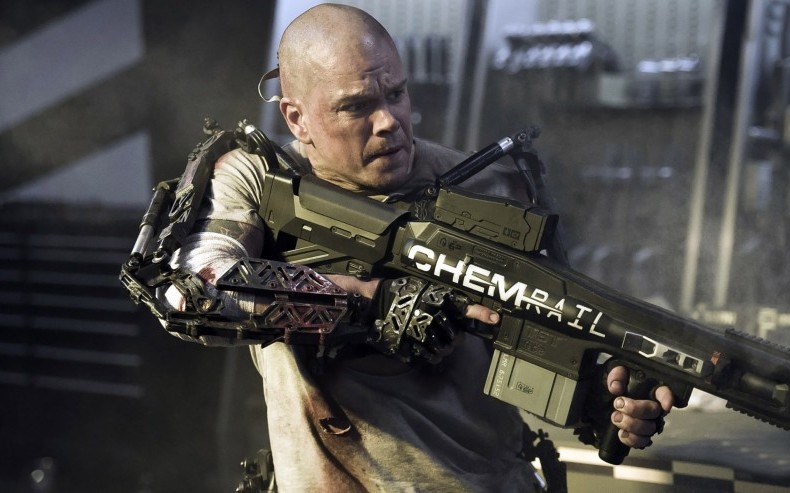
Elysium is the sophomore picture from director Neill Blomkamp, and if you’ve never seen his first film, District 9, and you’re about to go and see Elysium then I’m sure you’ll enjoy it a fair bit and you’ll have a great time. However, if you have seen District 9 and you’re about to go and see Elysium, then you might be a little bit disappointed. Not massively under-whelmed, but maybe just a little bit… oh. I mean, you might be left wanting a little bit more, that’s all.
District 9 is/was a gritty allegory on the apartheid regime in South Africa of recent history. Yes, it had aliens. But the message and story was clear; and it was a revelation. Elysium on the other hand also deals with segregation, of a sort. This time it’s the poor and lower classes that are dealt the bum hand with a lack of decent housing and – at the main crux of the film – medical care. Blomkamp shows us what could be our future. In some ways it already is (and he agrees).
Matt Damon plays Max, a blue-collar guy with an aggressive history and, after a rather grim work-place accident, a fairly short future. To get fixed, he needs to get the best medical care. The best medical care isn’t available on Earth, it can only be found on the orbiting space station for the upper classes – Elysium. Onboard, Jodie Foster rules with an iron first and she is not a fan of (amongst other things) unwanted visitors from Earth. You don’t need to be a rocket scientist to work what happens next but, nevertheless, it’s still quite fun watching how it plays out.
Sharlto Copley (star of D9, and also Howling Mad Murdoch in the A-Team film a while back)Â turns up, as a bad-ass sleeper agent, and really throws the cat amongst the pigeons. Creepy, dark, and murderous – Copley brings believability to what could be a one note and one dimensional bit part character.
But look, I know I started off saying that Elysium isn’t all that it’s cracked up to be, and I stand by that. On its own, Elysium is a fairly decent sci-fi flick that ticks a good few entertaining boxes while casting an interesting light over the discrepancies between the rich and the poor. The problem is: I can’t see Elysium as a film on its own. It is forever going to be in the shadow of District 9.
I mean, the opening shots, the scenery, the robotics, the cinematography – all of it, you may as well be watching District 9 again. Hell, they could even be set in the same universe – and that’s no bad thing. Except, when District 9 blew me away I hoped and hoped and hoped that Elysium would too. It didn’t.
I’m not in the habit of giving scores for films that I see but, if pressed, I’d give Elysium a 7/10. It’s not terrible. But if I had to see anything again at the weekend I’d probably pick something else.
I know I went nuts about Pacific Rim a while ago, but it really has to be said: The Way Way Back (TWWB) is one of my favourite films of the year.
It really is that good.
Following the (mis)adventures of a 14yr-old boy, Duncan (played brilliantly by one Liam James), TWWB tells the story of what happens when a geeky kid, who can’t take being around his mum and soon-to-be-stepdad’s jagged relationship much longer, sets off and tries to find his own way. This isn’t fantasy, this isn’t Pan’s Labyrinth levels of youth-based escapism – this is purely about one boy’s attempt to find some respite, and what he discovers along the way.
GAH! – SO GOOD.
Cast-wise, I’ve already mentioned Liam James, TWWB also features Sam Rockwell, Steve Carell and Toni Collette. Rockwell, as ever, kills it as the irresponsible water park manager that Duncan befriends; I laughed out loud a lot at his constant one liners (which I don’t doubt were result of much improv).
Toni Collete plays worrisome/stressed/straggled mum really quite well. Not as haunted as 6th Sense, and not as on edge as About A Boy – I’d put her performance somewhere in between with a smattering of broken-heartedness. In this context, it works.
Which brings us to Steve Carell.
I don’t know why but, I left the cinema thinking that TWWB could possibly be one of my favourite Steve Carell performances ever. Yeah, I know. Why? Because by the end of the film I ended up hating his character, Trent. Just absolutely despising him. Brilliantly under-played, Steve Carell brings a nuanced distrust to the film that is the cause of much stress and pain for more than just one or two characters. It’s just so darn subtle that you don’t even realise how much he’s effing things up until long after the film. Great work, Steve.
Oh! I nearly forgot Allison Janney! Remember CJ from The West Wing? Yes, her. Janney turns up in, I guess you could call it an extended cameo, and pretty much steals every she appears in. AMAZING.
TWWB reminded me, at times, of The Descendants. But this time, told from the kids’ perspective. It’s a beautiful summer town, there’s major stuff going on in the adults’ lives, but this time ’round we get to see what the young ones get up to, how they react and ultimately, how they grow. God this film is good. It’s an old school coming of age movie, that warms you to your bones.
If your’re missing the sunshine a little bit (and if you can find a cinema that’s still showing it) then go and see The Way Way Back. It’s a good end of summer movie that I thoroughly enjoyed It made me laugh, it made me sad, and it made reaffirmed my faith in the human race.
I think it’s one of those films that will be a little bit of a sleeper hit. It’ll do okay at the cinema but will eventually be amazing on home release and people talk about it and recommend it at parties – ‘Oh, did you see The Way Way Back? You have to see this film’ – then everyone will see it and then everyone will realise that it’s full of the best of everything.
Go see it.
PS. Big love and thanks to Luc Pestille: without his recommendation, I doubt I would’ve gone to see this. Thanks bud.
@LucPestille just seen it; it was perfect. I doubt I would’ve seen it if it wasn’t for your recommendation. Thank you.
Right, let’s get one thing absolutely clear: the first solo Wolverine film, or to give it its full title: X-Men Origins: Wolverine, was terrible. Arguably, second only to X-Men 3 (or X-Men: The Last Stand, depending on what side of the Atlantic you’re on) as being the worst X-Men film to date and it was not going to take much to do better.
And yet, what with early dicking about on the director front (we’ll come back to this later) and one of Marvel’s most ferocious characters being restrained enough to fit under a 12A rating, I stepped into the cinema with a touch of concern. I’d read a few (but not many) reviews, and early signs were good(ish); with an open mind, I sat down for The Wolverine.
For those that haven’t been paying attention, Wolverine is one of my all time favourite comic book characters. Wolverine #90 (Google it) was the first comic book I ever owned, and ever since he’s been my mainstay and anchor to the Marvel Universe. Fans of the comic books will know that the character has deep links with Japan, both in story and mythology, and so it follows that the land of the rising sun is the back drop for Hugh Jackman’s latest outing as the adamantium-clawed X-Man.
About Mr Jackman…
The Wolverine marks the sixth time the Aussie has played Logan and he has never looked better. Since seeing the film  I’ve been revisiting the earlier X-Men films and it is, quite frankly, incredible how much bigger he is. How much more Logan he is. Swagger, confidence, ‘Bub‘, it’s there. He has never been more Wolverine and this is best take on the character to date. I’ll say it again: he is HUGE, and it works.
– Wolverine from The Wolverine could eat two Wolverines from X-Men for breakfast –
Back to the film…
Directed by James Mangold, The Wolverine picks up with our eponymous hero dealing with the fallout of the events of X-Men 3 – hiding away from the world, and himself. However, when an old friend from Japan comes calling to repay a favour, things just go from bad to worse.
I mentioned earlier about the directorial ‘issues’ that faced the film. James Mangold is a competent director – I really enjoyed his take on 3:10 to Yuma and Walk the Line is pretty darn good too – but the problem, or what I thought would be a problem, is that he’s no Darren Aronofsky.
Indulge me for a second, a couple of years ago Aronofsky was signed onto direct The Wolverine. I wrote at the time (during my 1400 word love letter to his film-making) something like:
As a character, Logan deals with many, many problems within; memory loss, heartache, blood lust, a constant battle with the feral side of his nature that he keeps locked up and away from the human race, a healing factor that, while keeping long term injury at bay, does not shield him from any pain he might endure… This is what excites me.
–
These themes, these issues if you will, in the hands of Aronofsky are all ripe for his visceral style of film-making. In the very first X-Men film, Rogue asks Logan [about his claws]: “When they come out, does it hurt?â€Â Logan’s response is almost muted through the pain he is so numbed to by now; “Every time.â€
– That one response. Those simple two words. They – to me at least – signify everything that could be great about an Aronofsky take on this flawed, yet supremely (anti-)heroic comic book character. The pain. The anguish. The day to day struggle with the ‘red mist’…
It was set to be unlike any ‘comic book film’ you had ever seen. And I was busting a gut to see it.
As history now tells us, Aronofsky did six months work on the film, then pulled. Citing not wanting to be apart from his family as his reasons, rumours were afoot that it was in fact ‘creative differences’ that led him to part ways with FOX (reluctant to put an R/18 rating against their golden goose)- and Mangold was brought in in his place.
It was hard to watch a film, knowing what might’ve been BUT – and this is a huge BUT – there are still elements of Aronofsky there. Hugh Jackman was a big champion of Darren’s work (having worked with him previously on The Fountain) and worked solidly with him to deliver a worthy vision for the second Wolverine film (and genuinely wanted to make it up to the fans post Origins), so it is with thanks to the film’s star that the quality of that original vision remains at the core.
The Wolverine is not your traditional comic book film. I wouldn’t even go so far as to say that The Wolverine is an action film. It’s a character study, really, of our hero – what makes him tick, how he works and, ultimately, how he reacts under pressure. We’ve not seen this character in this situation before and, especially so far away from home, it makes for an enjoyable watch.
There are a few missteps, of course there are, but they can be forgiven as The Wolverine really does reward as the Wolverine film we have been all waiting for. Who cares if it’s lacking in mutants? Ghostly apparitions from previous films don’t bother me either. All I can say is, by the time the credits roll, you’ll be left feeling that you’ve actually been shown the level at which all future Wolverine films should be set. It’s just a shame that a) we had to sit through Origins to get here (that aside, the book is one of the best damn things I’ve ever read – so you should get that, like now) and b) we lost out on seeing the Aronofsky take.
Ah well, there’s always next time…
In closing, out of the six X-Men universe films to date, I would put The Wolverine in at a close number two (just under First Class). By that measurement, that means you should go and see it – right away. Right?
Whatley out.
PS. The mid-credits teaser is a doozy, definitely stay for that.
PPS: If you’re new to the X-Men franchise, which my plus one was, I strongly recommend watching the video below. Hell, even if you’re not new to the franchise, it’s still worth a watch. It’s funny, and it’s a decent refresher too.
And I’m not kidding. PACIFIC RIM was incredible. Just incredible. It’s everything you could want from a GIANT ROBOTS vs MONSTERS movie and more. Much, much more.
First off, if you only take one thing away from this review make it be this:
SEE PACIFIC RIM AT THE CINEMA. SEE IT BIG. SEE IT LOUD. BUT SEE IT HOW IT IS MEANT TO BE SEEN.Â
Both the Kaiju (the monsters) and the Jaegers (the robots) are huge. Monstrous even. And they have to be seen in IMAX to fully appreciate the magnitude of it all. But the spectacle of it all isn’t the only thing worth investing your time in, oh no. The story is actually fairly awesome, as is the emotional centre that sits within, underneath all that armour. As much as the trailer(s) would have you believe otherwise, PACIFIC RIM is not 131mins of non-stop gigantic city battles. It really isn’t.
There is humanity and story underneath and that itself is brought to life by a trio of decent leading actors. First, Charlie Hunnum, as our number one guy, Raleigh Becket, holds the film together really well and is not only our way in but also our way through this brave new world that we live in; supporting him we have the bloody fantastic Idris Elba (as Jaeger veteran Stacker Pentecost) and Rinko Kikuchi (as mystic Jaeger research assistant, Mako Mori). All three are great independently, but par excellence when thrown together – and it’s fortunate that that happens often.
The supporting characters are slightly one dimensional and, in places, seemingly only around for light relief. However each has a bearing on the story in some respect (again – I mention story – there is a lot of it here, and some smarts behind the Why? too) and each is given their time to shine… just.
The Good:
ALL OF THE GIANT THINGS (I may have mentioned this already)
The lead characters are, as mentioned, all really well fleshed out.
The title sequence: when it hits, it blows you away how much prologue you’ve just been given.
The CGI is second to none; you will believe these robot,s and these monsters, exist.
On a related note: this isn’t Transformers. The fight scenes are clear, there are rarely any cutaways and basically, you get to see EVERYTHING.
The Bad:
The story might be pretty good but the script, in places, is shockingly bad. If you’ve seen any of the trailers then you know that CANCELLING THE APOCALYPSE is possibly the singular most ridiculous line you’ve heard all year (well, outside of ‘UNLEASH THE WORLD ENGINE’ anyway). While they are few and far between, there are some humdingers in there and they CLUNK when they hit.
I mentioned one-dimensional characters earlier, there are a few – given the effort that goes into making so much of this world believable (especially the monster-ravaged China Town), it’s frustrating to experience so many unbelievable characters – and the acting isn’t super either.
There’s a bit, that I can’t talk about because it’s a bit spoilery, but when it happens you will, like me, scream at the screen: ‘WHAT?! WE HAD THAT THE WHOLE TIME?!’ – you wait, you’ll see.
The good news is, the bad is so far out-weighed by the awesome you can forgive PACIFIC RIM its shortcomings. It is an astonishing film and it is, without doubt, the best giant robots vs monsters film you will have ever seen.
I’m going to close off with something I read recently over by Tyler Cowen (on a blog post about how China is reshaping Hollywood):
You will note that in Pacific Rim they do not kiss, respect and loyalty to family are major motives in the plot, and there is nothing approaching a nude scene, except when the female lead sneakingly admires the torso of the male lead.
In a summer of mega-superheroes and leading men who always get the girl, PACIFIC RIM is a respectful giant of a movie, that stands up not only against the blockbusters of its ilk, but also against the better natures of some of the more lower budget efforts floating around too.
I first wrote about Oblivion back in December of 2012. I was excited about the premise, and I made five predictions on why it would be awesome. So, was I right?
Prediction 1: Tom Cruise does good sci-fi.
Yes, he does.
Prediction 2: It’s ‘WALL-E with guns’.
It is, and it isn’t. But as I said before: that’s no bad thing. This film borrows from many great sci-fi flicks actually, and the end result is better for it.
Prediction 3: It’s directed by Joseph Kosinski, so it’s bound to be good.
Kosinski’s last film was Tron: Legacy (which I loved) and there are echoes of that futuristic world scattered throughout. Again, this is no bad thing. The elder Kevin Flynn would live well in this universe, and he would approve of the decisions ultimately made there. Kosinski has a great eye and everything from the light used in the flying craft (see image above) to the base stations where our protagonist lives, has the touch of a talented sci-fi director. Good work sir.
Prediction 4: This future is imagined properly.
The year is 2070, the Earth is a barren wasteland, and yet the small areas we see are fully-fleshed out. To go into more detail would give away key plot parts of the film. Let’s just say that you believe that the Earth could end up this way; the vision of the Moon in this future is incredibly realised.
Prediction 5. I am a geek, so I’m definitely going to like it.
Right and wrong. I didn’t like this film because I’m a geek. I didn’t like this film because I’m a massive Tom Cruise fan (there, I said it). I liked this film because, as much as I was annoyed about the Morgan Freeman reveal shown in some (most/all) of the trailers, it still had so much left to show me. It just kept going, and going, and going, and going…
In closing, I really enjoyed Oblivion. Tom Cruise is great as Jack Harper and Andrea Riseborough is great (if not, better) as his tech-partner Victoria. Olga Kurylenko is OK, and the rest just serve to keep the plot moving forward.
For the nay-sayers out there you’ll be pleased to know there isn’t much TOM CRUISE RUNNING and there isn’t much TOM CRUISE BEING TOM CRUISE either. Oblivion is a well shot, well-directed, and well-thought through piece of sci-fi and definitely worth seeing big and loud.
The end.
Also in cinemas: TRANCE [terrible film, don’t bother].
Tonight I saw The Hobbit: An Unexpected Journey (AUJ) for the second time and at last, I can finally review it properly. You see, to me at least, to review a film in the right fashion you kind of need to see it in the original format the director intended.
While that isn’t always possible due to a number of reasons such as the age of the film (see: original Star Wars) or the rarity of the format it was shot in (see: Paul Thomas Anderson’s, 70mm version of The Master), for AUJ I had to make an exception and seek out both available formats.
Just before the New Year, I saw AUJ in ‘normal’ 2D at my local cinema, The Everyman. I was unsure at first; if you know anything about Tolkien’s The Hobbit, you’ll know that it is not only a children’s story that takes place before the events in The Lord of the Rings, but also a short story at that.
How they were going to stretch it out over THREE films was hard to imagine so, with the sound of money pouring into Warner Bros’ pockets echoing in my ears, I entered the cinema with much trepidation.
And I must say overall, it wasn’t that bad a film. The first half an hour or so is super self-indulgent (and entirely unnecessary), but once the journey in question gets underway, the pace picks up and you’re reminded of what it is to visit Middle Earth once again. Like Fellowship of the Ring before it, this first part of a trilogy combines a lot of character introductions with a lot of running and not really much plot development at all. One hopes that, again like The Lord of the Rings, things will get really interesting come part two.
One hopes.
That said, Martin Freeman is excellent as Bilbo and I would gladly sit through The Hobbit over and over again solely to watch the fantastic game of riddles set-piece with the scene-stealing keeper of the precious, Gollum (Andy Serkis, again proving he’s the best there is at mo-cap).
Speaking of seeing The Hobbit again, tonight I did just that. Thanks to some hardcore client work we delivered in the run up to Christmas, my team and I were treated to a private screening at Warner Bros – in full 3D and HFR.
‘What’s ‘HFR’?!’ I hear you cry. Well, sit down and I’ll tell you.
HFR stands for High Frame Rate, which is the very latest innovation in modern cinema. Basically it means doubling the frame rate from 24 to 48 frames per second which in turn results in a cleaner, more real (aka SUPER High Def) moving image.
But I don’t care about what others have said (and this is why I felt I had to see it in both formats before I could pass judgement), the addition of HFR really is quite fantastic. In short: I absolutely loved it. Although it can be quite jarring at first, you really can see this being the future of where cinema goes next.
Yes, it’s jarring at first – ‘it looks like a made-for-TV film!’, said some – but once you’re over the initial shock, it just works. In this instance. For this film. 99% of the time at least, it works.
What I mean is, for a film such as The Hobbit (where director, Peter Jackson, has meticulously created as much of the real world of Middle Earth against the backdrop of New Zealand and all/most outdoor scenes are just plain gorgeous to look at) shooting in HFR really brings home the sumptuousness of the scenery, of the characters placed in that scenery, and then the story that they tell together.
The 1% when it doesn’t work? When a format is built to show every minute detail, CGI sticks out like a sore thumb. This much I can forgive as, as with any new technology, there are teething problems and, given how far CGI has come over the past ten years, it won’t be an issue that much longer.
What that means is where effort is made to create the universe in question, HFR cinema can win – brilliantly.
I’d like to see a Ridley Scott film in HFR, I thought to myself mid-way through. His eye for detail and commitment to real-world creation would be perfect for this new format.
But I digress.
I’ve seen The Hobbit: An Unexpected Journey twice and I enjoyed so much more seeing it in 3D HFR. Therefore I recommend that you seek it out, enjoy the latest evolution in cinematic entertainment, and settle in for another chapter of Tolkien’s Middle Earth masterpiece.




 whatleydude.com