On Figuring Stuff Out

AKA ‘What does it mean to be a planner?’

I’ve been in research mode a fair bit of late. Whether that’s reviewing cross-category creative work to generate provocations for clients or doing a deep dive on the data surrounding the games industry’s ongoing round of redundancies (here’s Amir Satvat doing God’s work).

The exploration of these themes has meant spending a lot of time in effectiveness papers, case studies and spreadsheets; looking at data and talking to people IRL.

This kind of work, combined with a renewed dedication to just getting out there and spending time with other planners (hello APG friends!), it’s been nice to be reminded of what it is I love about what I do:

love figuring stuff out.

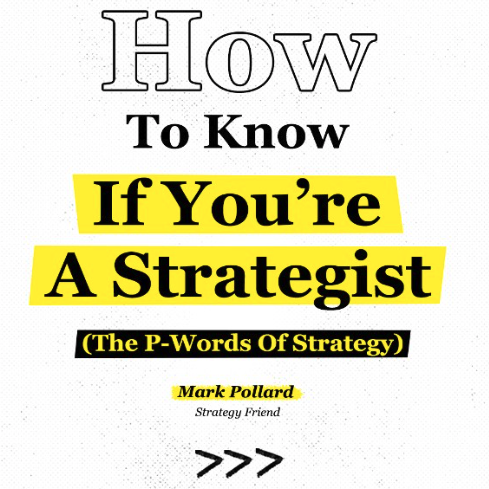
I was reminded of this again earlier this week when I came across this Linkedin post from Sweathead, titled: ‘How to know if you’re a strategist’ (the Seven Ps of Strategy).

A post that I kind of agree with?
think? 
Maybe?

The Ps mentioned are: Problems, People, Prying, Patterns, Possibility, Persistence, and Pitching.

It’s a pretty good list. If I could though, I’d probably add (or switch) two Ps in and maybe switch one P out.

Switch 1: PUZZLES.
I like solving puzzles – with data, with creativity, with strategic leaps. Problems are a good thing to uncover but getting to solutions figuring out the puzzle – that’s the main draw for me.

As a completely random aside: I once visited the International Intellectual and Puzzle Museum in Ulaanbaatar, Mongolia. To this day, one of the best days of my life.

Switch 2: PROVOCATIONS.
I like asking questions, yes. And those questions are always in service of getting to better work. But often-times you find yourselves in rooms (or on calls) where there are questions left unasked. The provocative question. The ‘Hang on, why are we actually doing this?’, or the ‘Yes but does the product actually deliver that?’ or the ‘Have we addressed why consumers don’t like you?’ questions. The hard questions you have to ask. And frankly, sometimes the only questions planners can ask.

Switch 3: PITCHING.
This is the one I’d probably switch out. Don’t get me wrong, I LOVE pitching. We pitched recently and a peer said to me as we were leaving the room ‘James, you were born to pitch’. So lovely. And we won the pitch too. Woop.

The point is, it reminded me that I am lucky to have had the training whereby I now enjoy those situations. So many planners and strategists I meet while, yes, they will at some point have to be able to convince a client of a certain strategic course of action, they might not always enjoy the process of PITCHING. Introversion is a common personality trope among planning folk.

Solving that? Well it’s a puzzle.

If you are a planner and you don’t enjoy pitching, then that’s OK. You don’t have to. You can learn, yes. You can also fake it ’til you make it. But if you hate it, that’s OK too and it doesn’t make you any less of a planner.

All of the above was originally published as part of my Five things on Friday newsletter and, in doing so, I think I accidentally managed to complete the three-writing briefs I set myself in my various social media profiles:

On writing.
On gaming.
And now,On figuring stuff out.

Ahh that makes me happy.

PS. ‘So you want to be a strategist‘ is still the best collection of learning materials I think I am yet to find for entry level strats and above.
How do you solve a problem like building gaming communities on Twitter? (aka ‘X’)

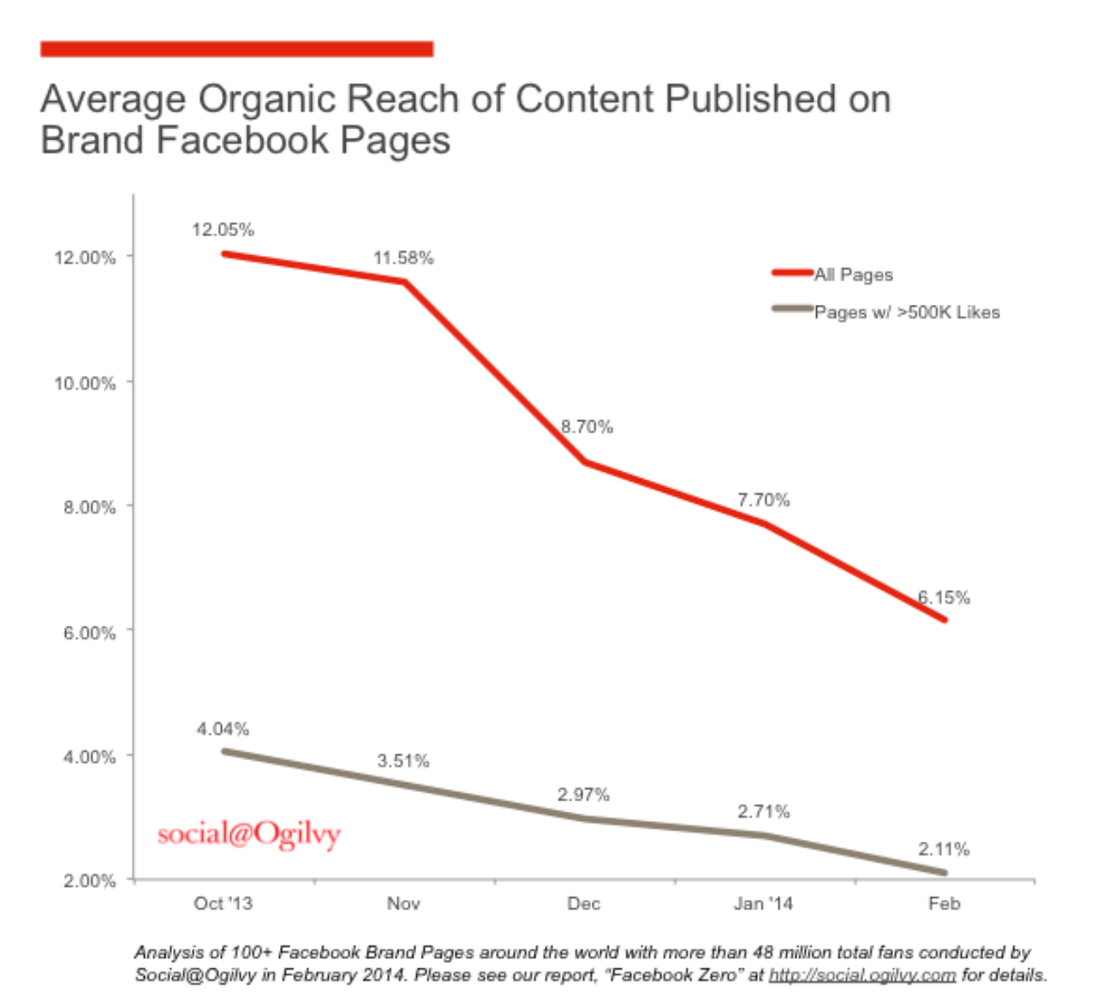
Ten years ago I was part of the research team that uncovered the slow death of organic reach for brand pages on Facebook.

Led by Marshall Manson and using data from over 100 agency managed brand pages, totalling more than 48 million fans, the Social@Ogilvy team were able to ascertain that organic reach for Facebook was facing a precipitous decline.


From October 2013 – February 2014, we could demonstrably prove that organic reach had dropped from 12% to 6%. That means for fan pages with 100 fans, any post with no paid media behind it would only reach six people.

In short: the free ride for brand fan pages was over. And the age of paid social had begun. Other social platforms soon followed. And in the years that followed, algorithmic content serving became king.

Since then, it became my standard to advise clients as often as possible to steer clear of an organic only approach to social media. To instead diversify your platform investment. To find new ways of not only building community, but doing so on a platform where you have ownership of – or at least reasonable access to the data. Valuable data that you can use for analysis, segmentation, retargeting and beyond.

Above all else, we eschewed the outdated KPIs of follower counts and fan chasing and instead focused on sharp paid media targeting and kick-ass creative.

In short: vanity metrics ain’t it.

If the lesson to stop building a fan following on one social platform wasn’t clear enough by now, you only need to look at the trash-fire that is the far-right, transphobic, sex-trafficker-supporting social platform formerly known as Twitter, X.

Earlier this year you could still see games publishers putting paid media spend behind asking X/Twitter users to ‘Follow this account for the latest updates’ about a new game.

Eg:


This is nuts.

According to the most recent research, the average half-life of a tweet is 24 minutes. Combine that with X/Twitter now purposefully obfuscating the organic reach metric (instead going with the non-unique nebulous number of ‘impressions’ – all views count, not just uniques), chasing vanity metrics is, at best, a dated KPI from the late noughties and at worst – a complete waste of time. Putting paid media behind that chase, even more so.

This alone should be cause for concern. When put against the recent shift of X/Twitter’s ownership, politics, and frankly, complete rejection of any and all brand safety – putting any spend into X/Twitter at all is… ill-advised.

OK so what’s the solution?

You might be reading this and thinking ‘Well, that’s not my experience’ – and you might be right. You might be experiencing a fantastic community on the platform and everything is amazing.

I doubt it, but you might.

You might also be reading this and screaming ‘James, Discord solves this!’- well, that is and isn’t the answer – the answer is and should always be ‘it depends’.

It depends what it is you’re trying to do. It depends on where you are in your game lifecycle. It depends on how much time/money you’re able to invest.

Learning how to diversify, test, learn and then commit. That’s the real trick.

But let’s get into it.

From AAA publisher to bedroom indie, the first question should always be: What is your objective? What is the one thing you’re actually trying to do?

‘I want brand awareness, community engagement, and sales’ – is not a single-minded objective. It’s three. The serious marketer chooses one.

‘I want to get 5000 followers on Instagram’ is not an objective. It’s a measurement. A measurement of what objective is the question.

‘I want an engaged community that I can reach with news and updates about my game’ – then the answer might be building Discord (for the core) or in fact, email (for mass).

Discord does of course have its pros. And many if not all of you reading this will be familiar with the platform. It is undeniable how useful it can be for developing that early/golden cohort of interest. However, you need to use it properly to drive engagement and interest. Talk to your fans, post regular / exclusive content. Engage in conversation. In Discord you have a captive audience, an audience that you can guarantee reach – so use it wisely. Don’t just auto-post your X/Twitter content. It’s lazy, disrespectful to the community and ultimately won’t deliver against your objective. You know who you are.

What about email?

We are without doubt in the age of the newsletter, whether you use Substack, Mailchimp or Ghost, newsletters are a great way to speak directly to people that actually want to hear from you. You get to own the first party database (hello, email!) and you get to sidestep the algorithmic content serving lords and masters of the social platforms. If email isn’t in your marketing channel plan, why not?

What else can we look at?

Well once again it comes down to your objective. If you’re building awareness, then for a small amount of investment you can do a surprising amount. From reaching new fans, building memory structures for existing, or even just giving announce trailers a paid media bump can be relatively simple and surprisingly cost effective.

If you need to drive interest on pre-orders, then ‘buy now’ carousels or stories/reels might do the job – and with the right creative execution then this too can deliver the results you’re after. All it takes is a clear brief and a commitment to a single objective.

There’s a lot here that should not come as a surprise.
It’s not rocket science.

The point is: when it comes to games marketing, the platform landscape is in flux. Single platform organic engagement can no longer be relied upon for reach and follower/fan vanity metrics are as out of date as the opinions you can find on the platforms you’re squandering effort in.

Endlessly chasing the same core set of gamers to like or follow the same accounts for single digit amounts of organic reach or worse – impressions – is a colossal waste of time and money. Blending a cross-platform organic approach with paid media, underpinned with an owned data driven platform (hello email), all in service to a clear single-minded objective is the route to genuine growth.

So how do you solve a problem like building communities on X/Twitter? Well the answer is simple: this problem was solved years ago, I’m just wondering when everyone else will catch on.

Note: this is an updated cross-post from an original Linkedin entry (where the comments are interesting and worth a look also).

What winning at Cannes feels like

Alright, let’s do this one more time.

Here’s another post about the 2023 Cannes Lions International Festival of Creativity

  • 26,992 Entries.
  • 12 shortlists.
  • Seven Lions.
  • Four Gold.
  • Two Silver.
  • One Bronze.

Seven Lions awarded at the peer reviewed and meticulously judged Cannes Lions. All seven for the Mondelēz International, OREO EU x Xbox Game Studios Publishing partnership, CHEAT COOKIES (or ‘#UnlockPlayfulness’ – market depending), that launched at the turn of 2023.

I led and sold in the strategy for this project when I was at Digitas UK, working with the amazing team at Saatchi & Saatchi Germany, in my role as European Strategy Lead for Mondelez bakery.

The clients have been amazing.

My friends have been amazing.

And my old team have sent a million selfies.

No alt text provided for this image
Looking good, lads – dream creative team of Ian & Gabriel

When I heard the news about winning Silver in the inaugural Entertainment – Gaming Lions, by a jury of led by head judge, Francine Li of Riot Games – well that was special.

According to Cannes, the Entertainment – Gaming Lions are weighted as follows: 20% strategy & insight; 30% creative idea; 30% craft & execution; 20% results.

And we got silver. In the first gaming Lions ever.

Massive.

And of course, winning a Silver after having only one Bronze to my name for so long was a huge deal.

The following night, when the news broke about the Four Gold Lions?

Well, I cried.

No alt text provided for this image
My old team, picking up another one in person.

I know it sounds mad but – for me – this shit is important. When it comes to the advertising industry, winning a Lion is it. Like that is IT.

People care about all the other awards, sure. But the big one, the one that really chuffing matters – it’s the Cannes Lion.

Winning a Lion at Cannes MATTERS.

I know this because the only other Lion that I have on my portfolio is the Bronze I’m credited on for the 2014 Expedia Group social media activation: Travel Your Tweet Interesting. And I’ve always been proud of that.

But I didn’t really know how truly important it was until I won Gold.

It’s what’s prompted me to write this.

I don’t talk about my upbringing or my background much. I’ve never really thought that it mattered. I was recently sent a book called ‘Making it in the Creative Industry: A Practical Guide’ – from the Creative Mentor Network – and it reminded me that actually, I’ve been really effing lucky to get where I am.

I grew up in Essex. Single parent family. Mum worked two jobs. I didn’t go to private school (I got my GSCEs at Castle View School, Canvey Island). I had free school dinners (I remember having to queue up at reception every lunchtime and get the little bus ticket voucher). I didn’t go to university and I don’t have a degree.

No one paid for me to get anywhere. No one opened doors. And I didn’t get into the industry by knowing or by being related to someone on the c-suite. I get it, I’m a white cis-het male and so the system is easier for me to navigate – there’s privilege there. I acknowledge that.

For now though, I guess I’m acknowledging my background. Something I’ve always tried to get away from: my working class roots. I’ve always been afraid of it. I owe a gratitude of thanks and learning to my dear pal, Jed Hallam. His Common People movement has helped me understand who I am, where I am, where I’ve come from, and what that means.

And today I’ve got four Gold Lions.

You may not care about Cannes. And you know what, if you’d asked me before this week, I probably would’ve said I don’t care as well.

But then we won. And I sobbed. Sobbed and sobbed and sobbed. Uncontrollably! Sobbed for the validation of my peers. Sobbed for achieving the heights on a campaign strategy and idea we believed in so much. Sobbed for all those bastards that never really knew what to do with me when they found me working in their team.

And yet here I am. With FOUR GOLD Lions.

Speechless. Utterly speechless.

Thanks to an amazing team (last round of thanks, promise):

At Saatch & Saatchi DE

Christian (creative leadership + vision), Miguel, Elvira (CS dream team), Stéphanie (air cover when we needed it), Ian, and Gabriel, (delivering the creative firepower)

At Digitas UK

James, Sarah (for picking up the strategic baton and running with it) and Matt (especially – for the freedom to work how I wanted to work, always providing the support when I needed it).

At Xbox (and Miai)

Gordon + Bolu (for being brilliant partners – up for everything and anything to help bring this to life).

And of course, at Mondelez:

Chiara, Jonathan, Guillaume, and Peter (for believing in the team and having the faith in us all to pull it off). You were ahead of the curve and it’s paid off in spades.

Finally, at home:

Annabelle – for always believing in me.

Congratulations one and all.

Can’t wait to celebrate in person.

James x

———

Those Lions in full:

GOLD: DIRECT, FOOD & DRINK

GOLD: CULTURE & CONTEXT

GOLD: AUDIENCE, SOCIAL INSIGHT & ENGAGEMENT

GOLD: BRANDED CONTENT, INSIGHT & STRATEGY

SILVER: ENTERTAINMENT FOR GAMING, PARTNERSHIPS

SILVER: GAMING, DATA & TECHNOLOGY

BRONZE: BRAND EXPERIENCE & ACTIVATION

‘Metaverse? What Metaverse?’

A video replay of my presentation at the recent BIMA Beyond: The Conference.

On June 29th, 2022 I was invited to speak at the BIMA Beyond Conference at Ministry of Sound, London. The talk itself, titled ‘Metaverse? What Metaverse?’ sparked a fair bit of interest (with one slide in-particular catching a fair amount of attention on LinkedIn – lol) and so, with BIMA’s permission, I’ve re-recorded the talk to camera for those that were unable to make it on the day.

If it’s at all helpful, I’ve also made the slides available on Google Slides (with additional speaker notes) so if you don’t want to watch the video, you can read along at home instead 🙂

The central premise is simple: the metaverse doesn’t exist.

The online virtual spaces that people are calling The Metaverse today are either dead and empty 3D spaces OR they’re simply video games, where hundreds of millions of players are already gaming day in, day out.

Why lean into a meaningless word when you can just do something cool in gaming instead?

‘The Metaverse doesn’t exist, you’re talking about gaming.’

This article was first published on The Drum – 17th May 2022 and is reproduced here with permission.

Depending on what you read, who you believe or what colour wool is being pulled over your eyes this week (it’s blue, it’s always blue), the metaverse could literally be any number of things, so let’s set some ground rules:

Rule 1: The metaverse does not exist. This is abundantly true. Whether you look it up on Wikipedia, read up on the dictionary definition or simply look at a briefing from Cambridge University’s Bennett Institute for Public Policy, they all say the same thing: the metaverse does not exist.

Rule 2: People that say the metaverse exists have no idea what they are talking about. Anybody that tells you they’re doing something ‘in the metaverse’ either has no idea what they’re talking about or is being willfully misleading about something cool in video games.

‘But what about Nikeland in Roblox?’ you might ask. Well, Roblox is not The Metaverse. Fortnite is not The Metaverse. Animal Crossing is not The Metaverse. Minecraft is not The Metaverse.

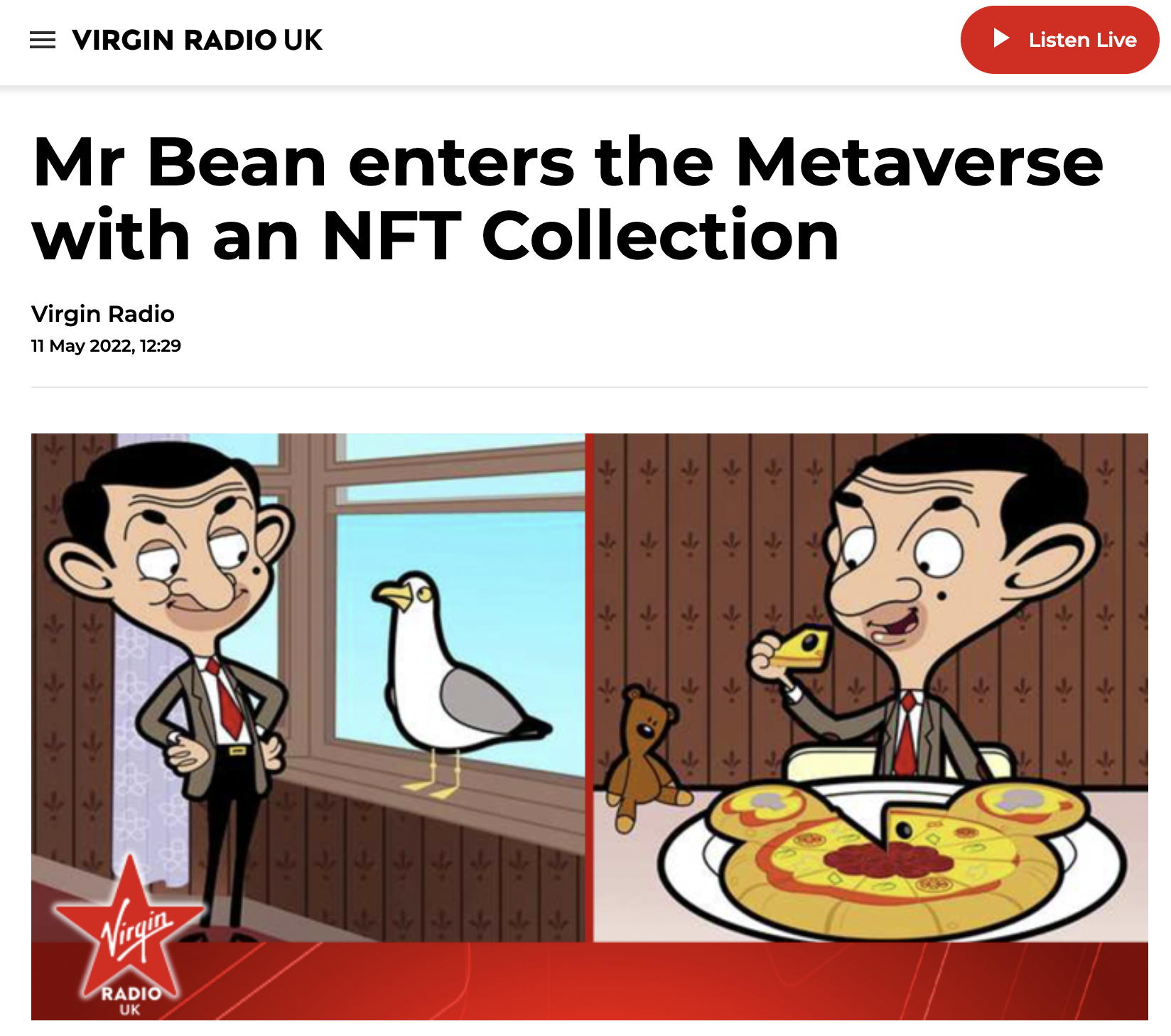
Mr Bean selling NFTs of his face is not the bloody metaverse.

(I wish I was making this one up)

I’ll say it again for the people at the back, the metaverse does not exist.

The things I’ve listed above are video games (well, all bar one of them). Great video games at that. With pre-existing communities of players of all ages and generational cohorts who are used to socialising, exploring and gaming together in the virtual online worlds and spaces where these games take place.

The metaverse is not a thing. Online virtual spaces where people have been hanging out to achieve things together have been around for decades. And if we just call things what they are, these things are video games.

Games.
Gaming.
Gamers.


These are not dirty words. It’s OK to say them out loud. They shouldn’t be frowned upon in the marketing dept (although metaverse should be) and in fact they should be held up and embraced. Sure, the metaverse sounds sexy and yes, I’m certain you all read about Gucci this and Balenciaga that in your Substack of choice last month, but these things are (mostly – but we’ll come back to that) just good video games partnerships.


And that’s OK.

So what if your Facebook/Instagram rep has been trying to sell you on just how much Meta are all building towards the metaverse (although how long for remains to be seen – quick, pivot to video!), just because they say tell you brands should all ‘GET READY! For! The! Metaverse!‘ it doesn’t make it real.

A 3D interconnected version of the internet where we all trade T-shirts as NFTs as seamlessly as we move around from one platform to another is about as realistic as the science-fiction movies rolled out in the opening slides of every single presentation you’ve ever seen on the topic (just add Snowcrash or Ready Player One to your next marketing conference bingo card, see what happens).

It ain’t happening this financial year, bud.
I highly doubt it’ll be in for next year either.

But hey, I tell you what. Let’s change track for a moment. Why not let’s indulge it for a second? Let’s imagine the metaverse did exist:

Are you tired of spending every waking hour on Zoom/Teams/Google looking at real people?
Why not do the same but with virtual people!
Imagine what you’ll do there…

Yes, actually. What will you do there?

In 2005, tech founder and investor Jyri Engeström coined the term ‘social object theory’. Building on the work of sociologist Karin Knorr Cetina, Engeström came up with – and subsequently implemented (we miss you, Jaiku) – this theory as part of his explanation as to why some social media networks succeed and some fail.

Social media networks need objects. Or, as Jyri put it: ‘Social network theory fails to recognize such real-world dynamics because its notion of sociality is limited to just people.’

Simply ‘connecting people’ is not enough. For example, Engeström argued at the time that much of the success of Flickr (remember Flickr?) was because user-generated photography served as social objects around which conversations of social networks could form.

And he was right.

This perhaps goes a long way to explain the success of Instagram (and, if we had more time, would no doubt provide a decent foundational argument for the vacant pornography of trauma that you see displayed on LinkedIn every day). But we’re not here to talk about that.

The point is: when online, people need something to talk about. They need ‘object centered sociality’. If you’re gathering, then the reason you gather needs to have purpose. On Instagram, it’s that amazing photo you took at Coachella. On Facebook, it’s your nan’s birthday. In Whatsapp, it’s the memed version of your best mate’s most recent terrible opinion. Posting images, videos, links, news stories, the latest misinformation from your Next Door community… it’s all what brings us together.

Without that reason, that thing to do or discuss, hanging out online is boring – meaningless, even. At best, this manifests itself as doom scrolling. At worst, it’s the endless monotony of over-filtered BS that fundamentally has no real meaning on real life except perhaps for the people desperately trying to present a version of themselves that people might like or talk about.

Which brings us back to our make-believe friend, the metaverse. If the metaverse ever did exist in any meaningful or successful way, then at the heart of it would need to be a reason for people to come together – a reason for people to converse, socialise and to play. A social object.

Or… a video game.

The good news is video games are already here. And they’re huge!

Understanding the audience – the communities – at the heart of this brave new world is key to any brand success in the future. But this brave new world is older than I am. And if you ask any of the inhabitants if they’ve been to the metaverse, they’ll laugh you out of group chat and kick you from the Discord server before you’ve even had a chance to show your logo in the first three seconds.

My point is, the metaverse and its inhabitants are all hypothetical. Gamers and players are real. And they’re already here.

So stop being afraid of the ’G’ word, drop the metaverse-hype, and come play.

A closer look at LEGO’s plan for a kid-friendly ‘metaverse’

Last week – and in light of the Epic x Lego partnership announcement – the nice people at Adweek asked me to comment asked me for some opinion on it all.

The Epic x Lego partnership (or ‘team up’ as they wonderfully call it) is one of the most interesting things to happen in the ‘metaverse’ space to date.

Why?

First, the announcement itself sets a clear agenda for Lego’s future in digital spaces. Second, it underlines Epic’s commitment to building safer online spaces for children to interact. This can only be a good thing.

If you look at online spaces worlds where children currently interact, you’re looking at Roblox, Minecraft, and Fortnite. Epic already has Fortnite but Epic does not have a Roblox or a Minecraft (aka: a platform that skews younger and for imaginations and builder to run wild).

So it’s a win/win.

Epic gets its own Roblox (and a phenomenal, globally-trusted kid-friendly brand to match), and Lego gets to start building something incredible with a respected partner that they know can live (and hold) to their brand values.

The deepening of the partnership with the further announcement that Epic have received $2 billion round of funding from existing investor Sony Group Corporation – as well as KIRKBI, the family-owned holding and investment company behind The LEGO Group, is a one two punch that very much cements Epic’s longer-term ambitions.

They mean business.

Which can only be a good thing for all of us. Because if you remove the marketing hype around the metaverse (and there’s a lot – so it might take a while) and look at this announcement for what it is, I believe we’re looking at the early beginnings of what could grow into a new persistent online gaming-led social space.

One that’s child-friendly, endorsed and built with digital Lego, powered by the powerful technology and talent at Epic, and almost certainly free to play.

It’s a way off, I’m sure. But if you take the even longer view on this, and look ahead to metaverse building companies being pulled in front of the DCMS, the European Commission, or even the US Senate. …who are legislators going to listen to when it comes to the safety of our children online? Mark Zuckerberg or Lego?

I think we all know the answer to that one.

An edited down version of this commentary was originally published on Adweek, April 11th, 2022.

Thoughts on ‘Digital’ job titles

Aka: ‘Creating noise where there was no signal in the first place’

Back in January, associate professor of marketing, brand expert, and Marketing Week columnist, Mark Ritson, published a piece on the ‘death of digital’ job titles.

It went a little something like this:

Screen Shot 2016-02-15 at 21.26.31

If you’re familiar with Ritson’s column, you can pretty much imagine the rest. I’m not one to bite when bait is so blatantly waggled in one’s direction but this is something that I’ve been niggling on for a while and, the other day, said niggle floated to the surface…

Via what some of you might refer to as ‘a mini Tweetstorm’:

//platform.twitter.com/widgets.js

Oh wait, a bit of background first. In case you missed it, Ritson’s piece came in response to another huge piece of industry news (January’s a slow news month) and that was [ad agency] Adam & Eve DDB’s move to ‘axe’ said D word from all job titles.

Ritson said:

The news that adam&eveDDB has dropped the digital designation from all its job titles came as no surprise last week. Despite the prevalence of the D word and the omnipresence of digital planners, digital strategists and digital marketers under every lamp post, nobody in the know ever doubted that the prefix would eventually become an anachronism.

And, unsurprisingly, the article (and the ‘news’ it referenced) became the talk of the town (which, when you think about it, is a&eDDB’s raison d’être).

And now everybody’s talking about it.

//platform.twitter.com/widgets.js

What I actually meant was #PredictionsBreakfast (hey, I was grumpy – I got it wrong). You know the event I’m talking about, right? It’s the one where I said this:

//platform.twitter.com/widgets.js

Someone in the audience (I think – it might’ve been Andy Oakes challenging us) asked the question ‘Are digital job titles dead?’ – I think my response was something along the lines of a big sigh, laughter, and then ‘no’.

Which is kinda how I got to the next bit –  

//platform.twitter.com/widgets.js

And I’d say that’s a fair enough comment. The term ‘digital’ means so many different things to so many different brands, agencies, publishers, partners, vendors – the list goes on – to simply ‘do away with it’ because it seems on trend is quite possibly the most ridiculous thing I’ve ever heard.

That said, I mean what I say: it could become redundant one day, maybe a generation from now – when the entire marketing job suite fully understands and gets what it means (and to whom). But that’s not going to happen this year and I very much doubt it’ll happen in the next.

And…

//platform.twitter.com/widgets.js

Which means that for the brands, campaigns, and projects that we work on, digital is a core component to nearly all of them. Do our partners need a experts? Undoubtedly. Do they feel more comfortable knowing they have a specialist on the case? Definitely. Would they give two hoots if we dropped it completely? Probably not.

But in the same way that products are designed to meet a consumer need, so are jobs created to meet client demand.

//platform.twitter.com/widgets.js

A small correction on this point. If you only read the headlines, you’d be forgiven* for thinking that a&eDDB had killed ‘digital’ only to replace it with the word ‘interactive’. The truth, as always, is slightly different. What a&eDDB have actually done is recategorised media into three areas: film, display, and interactive (more on that later).

So yes, replacing digital with interactive is a mistake – but let’s be clear: that is not what has happened here.

What has happened is that someone’s kick-started an intelligent debate about how we move the industry forward – and that a great thing (and should be commended).

Mark Ritson loves a rant (and I love him – sincerely, if you ever get a chance to see him lecture, GO), but on this there is a simple response: the industry just isn’t there yet.

//platform.twitter.com/widgets.js

//platform.twitter.com/widgets.js

…which means we’ll continue to have digital strategists, creatives, directors, etc… whatever’s required to get the job done.

Because ultimately, isn’t that the most important thing?

Thanks for reading.

JW.

__________________________

APPENDIX

– aka, related Tweets that I could find commentary for but are still worth your time.

//platform.twitter.com/widgets.js

Also

//platform.twitter.com/widgets.js

And my personal favourite…

//platform.twitter.com/widgets.js


*By ‘forgiven’, I mean ‘not forgiven at all’ – you should work harder at knowing more.

Useful links and data re: #Millennials

Someone asked me recently how they might discuss the topic of ‘How to best engage millennials’. I was quite happy with the braindump that I responded with, so I thought I’d [re-]share it here.

Y’know, just some resources / interesting reading and stuff.

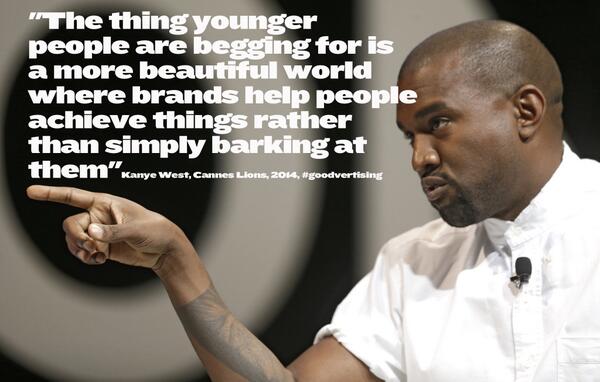
kanye

EDIT: I’ve decided that I’m going to try and keep this blog post updated with the latest findings on all things to do with millennials. The standard is high, so don’t expect to find Daily Mail headlines here. But yes, save this page and refer back to it later.

Last updated: Feb 25th, 2015.

Someone asked me recently how they might discuss the topic of ‘How to best engage millennials’. I was quite happy with the braindump that I responded with, so I thought I’d [re-]share it here.

Hope it’s useful.

__________

In answer to your question, this is what I throw at people in the office if/when they ask me about Millennials.

  1. This Marketing Magazine article touches upon a METRIC TON of stuff that my esteemed peer and colleague, Marshall Manson, and I have been covering recently across various media in regards to our 2015 Social Trends, have a read of that – it’s totally lifted some stuff from us wholesale but screw it, who actually cares?
  2. Speaking of that trend deck, Trend 3 (slide 36 onwards) of said presentation might also help (no guarantees made, obvs).
  3. I wrote this piece a little while back about how BRAND WITH PURPOSE will be the ones that talk to (and succeed with) the disillusioned millennial audience of today / tomorrow – #medianode
  4. White House report, “15 Economic Facts about Millennials
  5. BRANDS WITH PURPOSE is a trend on its own for 2015 (I’ve seen a book that’s coming in March that addresses the same thing and I’m certain We Are Social dropped a report recently that just reiterates everything in the article above.
  6. Also: ‘What’s current when nothing is certain?
  7. Pew Research on Millennials, including its reports on “Millennials in Adulthood” and “Who Are Europe’s Millennials?”
  8. The Drum have released a new ‘Millennial Hub‘ with Bauer – don’t know how good it is but it might be worth a look?
  9. There’s this Deloitte Millennial Survey 2014 (here’s the PDF exec summary)
  10. This is a great resource for illustrating the disillusionment of millennials (the last image nails it).
  11. Something something AUTHENTICITY.
  12. IBM report on millennials in the workplace
  13. What Millennials Want From Work‘ by HBR covers over 16k respondents in 43 countries and is actually a really good read.
  14. That HBR piece is itself lifted from a larger piece of work from a collaborative six-part effort to ‘understand a misunderstood generation‘ (it looks like it’s free to sign up too). This stuff is gold.
  15. Telefonica conducted its own Global Millennial Survey (also worth a look)
  16. Like infographics? Goldman Sachs have got you covered.
  17. Fusion Massive US Millennial Poll
  18. Knowledge @ Wharton article on “How Millennials Think Differently About Brands
  19. Mindshare did its own research (article coverage)
  20. How Millennials Get News (US-focused, again, but a fairly thorough process so some genuine insight here)
  21. More from Goldman Sachs.

That’s all I’ve got at the minute. Sorry.

Cheers,

JW.

PS. I’ve realised all I’ve done is give you loads of additional stuff to sift through. In answer to your broader question: you engage with Millennials by a) being authentic and b) having a purpose. There’s a Kanye West quote nails it. In fact just stick the image attached (posted above) on a slide and have done with it.

Trend Churn

When is a trend not a trend?

Recently I shared with you the official Ogilvy social media trend report that I co-wrote with a lovely chap named Marshall Manson.

Throughout the process, Marshall and I played around with what we each thought our trends were for the year, stress-testing the notions, cross-examining the evidence (and each other) and as a result, some awesome stuff made it in.

Sidenote: co-writing is fun. If you write, try and write with someone some time. It can be both challenging and rewarding and if you’re lucky, like me, you’ll strike gold with someone super smart to do it with.

There were other trends and ideas too mind: ones that we didn’t have the time to investigate properly, ones that we just couldn’t find enough (read: any) evidence to support, ones that we had put some thought into but hadn’t completely finished noodling on them yet, and ones for which we had a catchy title but no real substance (basically 90% of the trend dross out there today).

Normally we’d cut those but this time however we decided to keep some of those unfinished trends in the final document and, under the heading ‘Random stuff we haven’t figured out yet’,  they can be found from slide 40 onwards in said presentation.

Why am I telling you all this? Well, the one that came closest to making it was a little thing that I’d been ruminating on called Trend Churn.

_____________________________

Trend Churn?

The idea of Trend Churn was predominantly borne out of the micro trend known as ‘NORMCORE‘ making the leap from weird-ass white papers to actual ATL advertising and then arguably failing.

Miserably.

Gap – ‘Dress Normal’ / Wieden + Kennedy

dressnormal

“Sales at the Gap continued to drop in November, as its roundly-criticized “Dress Normal” fall campaign failed to drum up interest from consumers.

Gap’s comparable sales for November were down 4% versus a 2% increase last year. Sales were down 7% year-on-year in October and declined 3% in September. Gap’s other brands, Old Navy and Banana Republic, saw sales increase this last month — so this is a Gap-specific problem.” – Business Insider, December 2014

The word itself, ‘Normcore’, first came to my attention in a K-Hole trend report entitled ‘Youth Mode

The Youth Mode report introduces the problem of Mass Indie culture—“where everyone is so special that no one is special”—and proposes a new aspirational model in #Normcore, “a way of being that prioritizes self-identification over self-differentiation.” Normcore is like the smiley face emoticon, which K-HOLE uses so affectively: inclusive, basic, and human; an invitation to engage.

Makes perfect sense right? Right.

Turns out the whole thing was a non-starter. A non-trender, if you will.

And that is a trend itself.

The whole schtick I was pitching at Marshall was the idea that when the bright young trendy creatives are sucking up all the sexiest trend reports all at the same time, constantly under pressure to deliver The Next Big Thing, then surely at some point or another the Emperor’s latest threads will wind up in an ad somewhere.

shadwell

Samsung – ‘Be Your Own Label’ / Cheil Worldwide

“Samsung set to discontinue Galaxy Alpha in favor of cheaper phones. Production of the metal Alpha will reportedly end when the current inventory of materials runs out.” – The Verge, December 2014

The thing is with writing [a decent] trend report is that you really do need a number of proof points that at least go some way to validate your thinking.

Without those, it’s just a hunch report.

With Trend Churn, I didn’t have the data . I knew that Normcore had leaked into adland but I couldn’t find anywhere that actually measured its impact. Not without any meaningful evidence anyway. Everything in this piece so far is pretty circumstantial.

But you can see what I was noodling at.

I’ll leave you with this piece of solid gold, nabbed from an amazing blog post (from an amazing writer – Jenka Gurfinkel) called ‘The Possibly Real Trend of Real Trends

“In the days of slow-moving, 20th century media, emergent cultural expressions had time to incubate below the radar before they tipped into mass awareness. Pre-Tumblr, the only way to find out about a new cultural emergence was through the unassailably real channel of one of its actual practitioners. There was no need to wonder about veracity. Now, a nascent trend doesn’t really have the time to mature into something legitimate before the trendhunting hyenas descend upon it, exposing it to a sudden burst of scrutiny. What remains becomes neither niche enough to be authentic nor mass enough to be indisputable. Maybe no new trend seems quite real because it hasn’t had the chance to become real before we’re looking it up on urban dictionary and just as swiftly are click-baited on to the next dubious dopamine hit of meme culture.”


And in that one paragraph, Jenka nailed exactly the point I was getting at.

Watch for this in adland throughout 2015.

There’ll be more.

Much more.


..

As if you’ll notice.


Apple’s influence on advertising

When is an iPhone not an iPhone?

This is an iPhone.

iphone

The next three things are not iPhones.

Kitkats are not iPhones.

Somersby Cider? Not an iPhone.

IKEA: Book Book (not an iPhone).

You can’t deny Apple’s influence on modern advertising (even it’s other brands mocking or simply imitating its efforts). The IKEA one above is the latest and arguably best effort [to date] and everything from the casting, writing, and set up is completely spot on.

You also can’t deny that Apple makes great products. Better yet, everything about the company is geared towards making you feel great when you own one of then. From the service, to the stores, all the way through to its advertising.

I just love that its so open to mockery.

That is all.

—- UPDATE —-

Since publishing this post quite a few people have pointed out another remarkably similar piece of work, from five years ago, for The Sun Newspaper.

Watch this, then watch the IKEA one again.

A rip-off of a rip-off?

Damn.