At the tail end of last year (and after much deliberation; is it poncy, is it not?) I added a ‘Speaking’ tab to my blog. First, to record all the speaking engagements that I am lucky enough to get/give and second, to serve as a way for folk to not only see the way I work, but also get in touch should they wish to book me.
Last year topped out at three different presentations and talks, and given that 2011’s end number was six, I really don’t think this is good enough.
After reviewing last year’s fairly lacklustre efforts I decided that this year, 2013, I’m going to proactively hunt down new speaking opportunities and get back into the swing of things again. The best thing is, my new responsibilities at Ogilvy now allow me the freedom to pursue this goal, which means I can make the time where appropriate. Brilliant.
Saying it is one thing, but doing it is another – a bit like running, really; you just need to put the effort in. Which is why, after only three weeks gone in the year, there are four slots already on the horizon!
January 24th
Then on Thursday, I’m one of the speakers at the SalesForce Social Success Mic-Up. This time speaking about social media trends looking forward into 2013. I made some predictions in August last year and for this sessions I’ll be building on those and trying to see what else we can see coming ’round the corner.
Two confirmed, and two under discussion. If the latter come in, I’ve already beaten last year’s score. Perfect.
It’s amazing what you can achieve when you set yourself a goal like that.
This past week, thanks to a rather awesome Christmas present, I was given the chance to appear in a cameo role in the current West End run of Monty Python’s SPAMALOT!
AND.
IT.
WAS.
AWESOME.
Looking back on it now, a good four days later, I still can’t believe it happened! It’s difficult to communicate (using just the written word) how great the whole thing really was. So it’s a good job I took a load of pictures to help me tell the story!
Part 1. Arriving at the Stage Door The crew greeted us warmly, and were just super super nice about EVERYTHING. ‘Hey! James is here!’ – ‘Is that the Sir Not Appearing?’ – ‘Yeah!’ – ‘Hey everyone! Our Sir Not Appearing is here!’
I turned up with literally zero knowledge of what I was going to be doing or what my line was (didn’t I mention? It was a speaking part too!) as I was kept in the dark right up until arrival. So this whole ‘Sir Not Appearing’ thing? I had no idea what they meant…
The stage manager met us and explained everything:
There’s a part in the play, around two thirds through the first act, when the narrator, after King Arthur has rounded up his men, reads through the names of the Knights of the Round Table… and the last name he reads is ‘the aptly named ‘Sir-not-appearing-in-this-play’. You come on at that point, you say ‘Sorry!’ and then you leave. Easy! Don’t worry, we’ll be rehearsing at around 730pm, plenty of time!
Any fan of the original Monty Python and the Holy Grail knows that this only a slight variation on the film’s script:
NARRATOR: The wise Sir Bedevere was the first to join King Arthur’s knights, but other illustrious names were soon to follow: Sir Launcelot the Brave; Sir Galahad the Pure; and Sir Robin the Not-quite-so-brave-as-Sir-Launcelot who had nearly fought the Dragon of Agnnor, who had nearly stood up to the vicious Chicken of Bristol and who had personally wet himself at the Battle of Badon Hill; and the aptly named Sir Not-Appearing-in-This-Film. Together they formed a band whose names and deeds were to be retold throughout the centuries, the Knights of the Round Table.
Part 2. Costume!
[Note – for reasons that will become clear very shortly, I had to shave off my beard. I look about 12yrs old! ARRGH!]
3. Meet the star! For this run (initially scheduled for a limited six week run but now, thanks to its popularity, on an indefinite extension) of SPAMALOT! King Arthur is played by the one and only Stephen Tompkinson.
And what a bloody nice bloke he is too.
Part of the evening’s plan (aside from being a special guest star (ahem, yes – that’s me)) was to meet Stephen backstage and chat to him about all things Python. Again, something I didn’t know was happening until the night and again, something equally brilliant for me to do!
Things Stephen told me about Spamalot:
His daughter, with whom he has watched Monty Python’s Holy Grail several times a year, every years, since she was six years old, was the one to convince him to take the role! ‘You’d make me so proud, Daddy!’ – she said to him. ‘How could I say no to that’ he said. Awww!
His rehearsal process was a mere ten days. TEN. DAYS. Mental. Alright that’s a pretty intense ten days, but still – I can’t imagine. Fortunately for Stephen, he is only one of two new additions to the cast (the other being the quite brilliant AJ Casey, as The Lady of the Lake) so the ensemble already in place not only welcomed him with open arms but also supported him every step of the way.
The name of the game [on this production at least] is Fun! That’s what the director told Stephen on his first night – ‘Just forget your troubles, get out on that stage and have a riot. The audience want to have fun with you, so just have a ball!’
This new [ish] version of the play is a lot more inclusive and open than it was in the Palace and is updated accordingly to very current affairs – songs as well!
What a lovely chap. And there was still so much more to come!
4. Rehearsals
Again, another moment for the cast to be warm and welcoming. I got my part right first time, and they all cheered and whooped.. Ha! Just, brilliant.
5. Waiting!
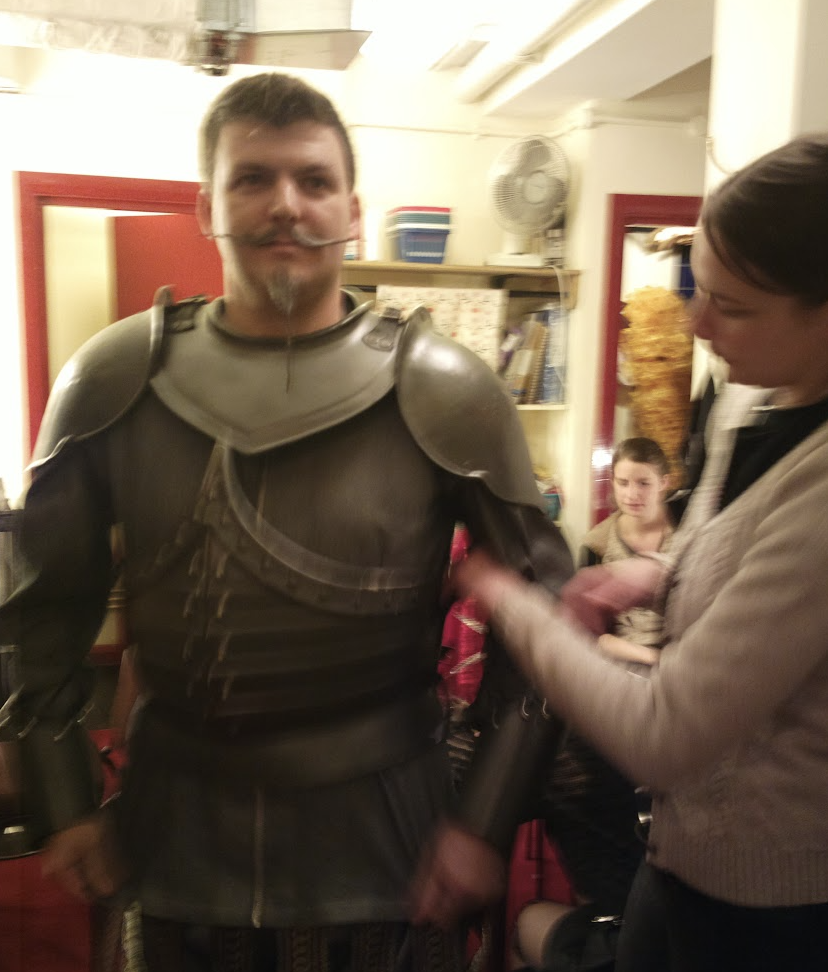
6. Final, blurry adjustments Armour, moustache, and beard (yes, that’s right – I shaved my beard so I could wear a fake one, brilliant).
Before showtime!
7. The show! Backstage the atmosphere was, how can I put it? Hilarious. Laughter, jokes, and merriment were spewing forth from everyone – and that was before anyone was on stage! It was such a great group of people to be around; they clearly loved their work very, very much and every single person who walked past whilst I was waiting in the wings stopped to wish me luck, before they themselves stepped out in front of 700+ people.
Just lovely, lovely people.
When my cue – ‘and the aptly-named…‘ – came I strutted out on stage and beamed at the audience – ‘…Sir-not-appearing-in-this-play!’
In four beats: the knights looked at me, I looked at them, I looked back at the audience, and then came the line:
‘SORRY!!!’
And the next thing I knew, I was off again – to roars of laughter!
The audience’s reaction was great, and I was grinning from ear to ear.
I was [and still am really] utterly dumbfounded that the whole thing took place at all. I can’t believe it. It was just brilliant.
The team backstage told us that the role of ‘Sir Not Appearing’ is usually played by one of the ensemble however they often throw it open to special guest stars such as celebrities and/or comedians who can come on and kill with that role. In other words, for me to get the opportunity to do it was very special indeed.
Just. Wow.
And while I can’t guarantee that I’m going to be in it next time, I can 100% guarantee that seeing this play will make you laugh. A LOT. I laughed like a madman, both backstage during act one and then again when I joined the audience for act two.
So yes, go and see Spamalot. Please. It’s AWESOME. Hilarious, laugh-out-loud funny, and… and the cast just has so much fun.
It would be unfair of me to mention the epic corpsing that took place during the Knights that say Ne segment, so I won’t.
Yesterday, news landed in my inbox that Nokia were going to not only announce the availability of 3D-printed cases for the Lumia 820 but also – and here’s the killer – release the printing files for said cases too.
That’s. Just. Awesome.
Why?
Let’s review.
The Lumia 820 is Nokia’s next best flagship Windows Phone 8 device after the Lumia 920. One key point of difference between the two is that the former has, like old-skool Nokias of the past, a hot-swappable back cover; allowing 820-owners to personalise their devices to the colour of their choosing. Well, from the available range (above) at least anyway…
That last part – the limited choice – all changed yesterday.
With the introduction of (and then the public releasing of the files for), 3D printed covers anyone with a 3D printer can create their own Lumia 820 back cover.
Yesterday was stacked and I’ve only now got the time to write this up. Since the announcement, the news has appeared everywhere; from Wired through to the BBC. However – leading Indian mobile tech blog, Unleash the Phones, managed to get the scoop on them all by laying their hands on the first images of what these 3D printed covers look like –
These were made, in about an hour, with Makerbot. Amazing.
Yes, the technology is expensive. But so were 2D printers when they first launched. With today’s yesterday’s announcement Nokia have given us a glimpse of the future and, dare I say it, earned [back] a whole lot of geek/cool points in doing so.
Good job.
—————–
Here’s the news from Nokia’s blog, (including said files!)
Releasing the 3D printing files for Lumia 920:
Nokia’s 3D printing community project is a simple concept with exciting potential. Our Lumia 820 has a removable shell that users can replace with Nokia-made shells in different colors, special ruggedized shells with extra shock and dust protection, and shells that add wireless charging capabilities found in the high-end Lumia 920 to the mid-range 820. Those are fantastic cases, and a great option for the vast majority of Nokia’s Lumia 820 customers. But in addition to that, we are going to release 3D templates, case specs, recommended materials and best practices—everything someone versed in 3D printing needs to print their own custom Lumia 820 case. We refer to these files and documents collectively as a 3D-printing Development Kit, or 3DK for short.
The links to the files needed are here, here and here.
In doing this, Nokia has become the first major phone company to begin embracing the 3D printing community and its incredible potential, and continue to be the leading phone company in this exciting field.
[We] view this as the spiritual successor to the great granddaddy of customizable phones, the Nokia 5110 and its rainbow collection of removable faceplates. To think, it’s been 15 years since the 5110 launched!Â
—————–
At this point, one would normally write something like: ‘So, what do you think? Do you have a 3D printer? Will you be trying this out? Have Nokia done the right thing?’ – to help stimulate conversation in the comments etc..
But no. Not today. Instead I’m going to say this:
IF YOU HAVE A 3D PRINTER PLEASE CAN I COME AND PLAY WITH IT?
“We live in an age when distraction is everywhere, consumers are multi-screening – and multi-screening is actually an acceptable verb – and the industry assumes that to get what marketing departments call cut-through or mind-share for music you have to bombard people: artists are supposed to be in a constant dialogue with their fans, via Twitter or blogs or Facebook. It’s a timely reminder that mystique is a valuable commodity. You can perhaps give people more by giving them less.”
Explaining (in quite fantastic detail) how exactly, in an age of cameraphones and gossip websites and social media, Bowie’s album remained under wraps for two whole years before appearing, seemingly out of nowhere, last Tuesday – it is a great read.
It seems we could all learn a thing or two from Mr Bowie.
Tonight I saw The Hobbit: An Unexpected Journey (AUJ) for the second time and at last, I can finally review it properly. You see, to me at least, to review a film in the right fashion you kind of need to see it in the original format the director intended.
While that isn’t always possible due to a number of reasons such as the age of the film (see: original Star Wars) or the rarity of the format it was shot in (see: Paul Thomas Anderson’s, 70mm version of The Master), for AUJ I had to make an exception and seek out both available formats.
Just before the New Year, I saw AUJ in ‘normal’ 2D at my local cinema, The Everyman. I was unsure at first; if you know anything about Tolkien’s The Hobbit, you’ll know that it is not only a children’s story that takes place before the events in The Lord of the Rings, but also a short story at that.
How they were going to stretch it out over THREE films was hard to imagine so, with the sound of money pouring into Warner Bros’ pockets echoing in my ears, I entered the cinema with much trepidation.
And I must say overall, it wasn’t that bad a film. The first half an hour or so is super self-indulgent (and entirely unnecessary), but once the journey in question gets underway, the pace picks up and you’re reminded of what it is to visit Middle Earth once again. Like Fellowship of the Ring before it, this first part of a trilogy combines a lot of character introductions with a lot of running and not really much plot development at all. One hopes that, again like The Lord of the Rings, things will get really interesting come part two.
One hopes.
That said, Martin Freeman is excellent as Bilbo and I would gladly sit through The Hobbit over and over again solely to watch the fantastic game of riddles set-piece with the scene-stealing keeper of the precious, Gollum (Andy Serkis, again proving he’s the best there is at mo-cap).
Speaking of seeing The Hobbit again, tonight I did just that. Thanks to some hardcore client work we delivered in the run up to Christmas, my team and I were treated to a private screening at Warner Bros – in full 3D and HFR.
‘What’s ‘HFR’?!’ I hear you cry. Well, sit down and I’ll tell you.
HFR stands for High Frame Rate, which is the very latest innovation in modern cinema. Basically it means doubling the frame rate from 24 to 48 frames per second which in turn results in a cleaner, more real (aka SUPER High Def) moving image.
But I don’t care about what others have said (and this is why I felt I had to see it in both formats before I could pass judgement), the addition of HFR really is quite fantastic. In short: I absolutely loved it. Although it can be quite jarring at first, you really can see this being the future of where cinema goes next.
Yes, it’s jarring at first – ‘it looks like a made-for-TV film!’, said some – but once you’re over the initial shock, it just works. In this instance. For this film. 99% of the time at least, it works.
What I mean is, for a film such as The Hobbit (where director, Peter Jackson, has meticulously created as much of the real world of Middle Earth against the backdrop of New Zealand and all/most outdoor scenes are just plain gorgeous to look at) shooting in HFR really brings home the sumptuousness of the scenery, of the characters placed in that scenery, and then the story that they tell together.
The 1% when it doesn’t work? When a format is built to show every minute detail, CGI sticks out like a sore thumb. This much I can forgive as, as with any new technology, there are teething problems and, given how far CGI has come over the past ten years, it won’t be an issue that much longer.
What that means is where effort is made to create the universe in question, HFR cinema can win – brilliantly.
I’d like to see a Ridley Scott film in HFR, I thought to myself mid-way through. His eye for detail and commitment to real-world creation would be perfect for this new format.
But I digress.
I’ve seen The Hobbit: An Unexpected Journey twice and I enjoyed so much more seeing it in 3D HFR. Therefore I recommend that you seek it out, enjoy the latest evolution in cinematic entertainment, and settle in for another chapter of Tolkien’s Middle Earth masterpiece.
In lieu of rebooting Five things on Friday (not happening), here’s a round-up of some of the more interesting things I’ve been reading on the web this year –
1. Magic pickpocketry Apollo Robbins is the world’s best pickpocket. You’ve never heard of him but, within magic circles and beyond, he is somewhat of a legend. Neuroscientists, the military and anthropologists have all worked with Apollo to try and discover how he creates his particular form of distraction and extraction – this New Yorker piece is a great read.
On an encounter with Penn Jillette (of world-renowned double act ‘Penn & Teller‘) at a recent Las Vegas magician’s convention –
Jillette, who ranks pickpockets, he says, “a few notches below hypnotists on the show-biz totem pole,†was holding court at a table of colleagues, and he asked Robbins for a demonstration, ready to be unimpressed. Robbins demurred, claiming that he felt uncomfortable working in front of other magicians. He pointed out that, since Jillette was wearing only shorts and a sports shirt, he wouldn’t have much to work with. –
“Come on,†Jillette said. “Steal something from me.†–
Again, Robbins begged off, but he offered to do a trick instead. He instructed Jillette to place a ring that he was wearing on a piece of paper and trace its outline with a pen. By now, a small crowd had gathered. Jillette removed his ring, put it down on the paper, unclipped a pen from his shirt, and leaned forward, preparing to draw. After a moment, he froze and looked up. His face was pale. –
“F***. You,†he said, and slumped into a chair. –
Robbins held up a thin, cylindrical object: the cartridge from Jillette’s pen.
2. Wi-Fi on the Underground
This year it’s pretty much free to use for Orange, Vodafone, EE and T-Mobile customers. Except, no one seems to have told T-Mobile.
‘Hey left hand, what you up to?’ – ‘Sorry right hand, can’t tell you’.Â
3. What three completely unrelated movies can you put together that if the story lines continued would make a good trilogy?
The above is one of the best questions I’ve seen on reddit this week, my favourite response so far?
‘Home Alone / Saw / Cube. It’s the story of a boy who takes booby trapping his house to more and more ridiculous extremes.’
It is 1979. Rare is the actor who doesn’t snort, pop, or guzzle. Landis, a teetotaler, misses the bigger picture. “We had a budget in the movie for cocaine for night shoots,†Aykroyd says. “Everyone did it, including me. Never to excess, and not ever to where I wanted to buy it or have it. [But] John, he just loved what it did. It sort of brought him alive at night—that superpower feeling where you start to talk and converse and figure you can solve all the world’s problems.â€
And –
Three months later, Belushi’s first movie opens. This is Animal House. Belushi, having played Bluto, the gluttonous rascal who rallies Delta House to glory, becomes a Major Movie Star.
This is good. During an out-of-town car trip, Belushi asks Aykroyd to stop the car, saying, “Watch this! Watch this!†Aykroyd recounts that “he gets out of the car and starts knocking on the ground-floor windows of this primary school, knowing he’ll get a reaction. By the time we left, all the windows are up and the whole school is chanting, ‘Bluto! Bluto!’ â€
It really is a fantastic read and worth at least 20mins of your time.
5. The Basement ‘Somewhere in Portland, there’s a very old building, and that very old building has a very, very old basement. An incredible basement, a video-game-level basement, a set-decorator’s dream basement.’
It’s a short story, in a way. More of an exploration… of history. The clues, the stories, and the secrets. It’s quite the photo journal and, again, well worth your attention.
noun[mass noun]
– the action or movement of a runner: his running tore United to shreds – the sport of racing on foot: marathon running
_______________________________
I’m not a big one for resolutions. Hell, I haven’t even made any this year. But a strange thing happened on January 1st, something that I’m not sure has happened to me before; I woke up, around 8am, having only had only around 3-4hrs sleep (after much fun and shenanigans on NYE, of course) and I wanted to go on a run.
And the following day I did it again, and the day after that I ran again, and then on the 4th? Well, then I took a break. It seems not running for years and then taking it up again suddenly and rather aggressively isn’t the way to do these things. There was limping, and a fair bit of pain, and all my running friends (turns out I have a few) came out of the woodwork to advise on all sorts.
So here we go: the complete 100% newbie and unscientific list of things to do if you’re going to start running:
1. Actually go for a run
Yeah, it seems an obvious one but getting out there and doing it is the easiest way forward. Get that out of the way and you’re halfway there. No, scratch that, you’re all of the way there. You have done some running. Well done.
2. Warm up (and then down again) I didn’t do this at first and I suffered for it. I recommend you don’t make that mistake.
Warming up? Some stretching before you head out is definitely a good idea (thanks to the comments, only stretch AFTER your workout – see I am a newbie! However you should definitely) Consider ‘briskly’ walking for the first five minutes of the route you’re about to embark upon. Stupid really, you’d think people would know to do this. Even when I went for my first run I remember thinking ‘Yup, we definitely used to warm before any sports in PE at school… but I’m an adult now! I don’t need to deal with such tomfoolery!’ – I am a numpty, clearly. But that means you could be too. SO WARM UP, (then do some stretching when you’re done too).
And that’s it really. Straight up – that. is. it.
Warm up. Run. Warm down. Done.
Well, there’s a few more, but these next few are 100% optional.
3. Pick an app
There are a whole ton of sports-tracking apps available for your selection, each of them measuring all kinds of things from the route you take, through to your avg. speed; some can plug into other services and some you can integrate into your entire LIFE.
Endomondo, Run Keeper, Nike+, there’s loads. Me? I’ve gone for Sports Tracker. Why? It’s across the most platforms and, given that I swap phones every month, it’s the best one there is. Your choice might be different. Do some research.
4. Get the right kit
When I say ‘kit’, I mean – these are the things that I don’t run without –
First up, my hoodie. It’s bloody cold out there at the moment (and it won’t be getting warmer anytime soon) and I’ve got one of those Superdry hoodies which is pretty damn cosy, and good for running in. It’s not rained yet, so I don’t if it does actually keep me Superdry, but only time will tell (christ, rain. I hadn’t thought about that). Either way, it does the job. Winner.
Second, my mobile. CurrentlyUp until yesterday* this iswas a Nokia Lumia 920** and [while it’s not the most robust handset in the world] it has done a good job of not only tracking my runs to date, but also providing the tunes to said workouts too.
Finally, some decent shoes!
I got the above bad boy Asics from Runners Need on Great Portland Street. They cost me £70 and I got a free gait-analysis thrown in too. I’d never heard of that analysis part before but those running friends I told you about earlier? They all swear by it. Get tested, then get the trainers you need to mate.
Again, this isn’t gospel; you can run in plimsols if you so wish! However, I’m committing to this (hence the bloggage too I guess) and want the kit to see me through. And hey, if you find yourself on the streets of Maida Vale one morning (say around 7ish), look out for this knackered-looking guy –
My first post of 2013 is about mobile? Didn’t see that one coming…
Ubuntu, from Canonical (an operating system I have never used (not an irrelevant point)), is coming to mobile. Haven’t you heard? OK, well watch the video embedded below (from about 5mins 20secs onwards) to get a brief rundown.
In fact, if you’ve got 20mins (like I had earlier, in the bath (there’s a mental image for you)), you should watch it all – it’s pretty good.
Got that? Right.
Five things you should know –
1. I am not an Ubuntu user
I’ll say it again: I am not an Ubuntu user. Not many of my friends are either. According to Wikipedia, Ubuntu is ‘the most popular Linux distribution on the market’. That’s a little bit like saying you’re the most popular kid in New Jersey but hey, who’s counting.
My point is (based on the super-scientific research of me and my mates – clearly) Ubuntu isn’t exactly consumer friendly and/or focused (yet). This might work against them, it might work for them. But we’ll come back to that one.
2. Oh my N9
The Nokia N9 was (still is, to be fair) a gorgeous phone. I still have mine. At the time, Meego’s SWIPE UI was innovative as hell and just so damn good to use. New Ubuntu for mobile has clearly borrowed heavily from Meego in this area.
Swipe left to do this, swipe right to do that; it’s a great interface. And, while I’m happy to see it being used, it makes me sad when I think about what the N9 might’ve been [had Nokia not decided to go all in with Windows Phone].
3. Disingenuous(?) Commentary
The supersmartchaps spotted chatting in the video from 14mins onwards make some really interesting and valid points. But – and you may think this yourself when you watch it – the comments are bit generic and fluffy. But that’s not their fault, it was down to the questions asked and the edits made afterwards –
@whatleydude @dsample @loudmouthman Didn’t realise that version was public. The edits make us sound a little more positive than I am.
4. We’ve been here before, remember?
Back in November 2007 (a mere five years ago) Google (re-)launched Android into the world. ‘It’s an operating system for geeks!’ the nay-sayers yelled. And they were right, for a time. One might argue that is still very much the case BUT ONE WOULD DEFINITELY BE WRONG.
Android is the number one mobile OS in the world today. Five years after the industry signed it off as ‘just for geeks’. Alright Ubuntu isn’t Google but still, don’t discount them yet – sometimes being the underdog really helps. Speaking of Google…
5. Hardware vs Software According to sources, a build of Ubuntu for mobile will be ready for download and installation onto Google Nexus devices within the next three weeks. If you made it through the video above, then you probably already know that ‘if your hardware works with Android, then it’ll also work with Ubuntu’ – which is basically Ubuntu saying ‘We work on Google phones!’.
That to me is awesome.
That means we are one more step closer to separating hardware and software in mobile. That means, like in the PC world, you could buy a Google Nexus device and then ostensibly install any OS you want on it [within reason]. This level of disruption can only be good for the market.
In closing:
Consumers don’t care for (or even know about) Ubuntu, but consumers didn’t care about Android when that first launched and look where we are now. The OS itself looks innovative and exciting, the market is screaming out for disruption (Windows Phone isn’t quite there yet), and perhaps, just perhaps, Ubuntu for mobile might be an(other) interesting way forward.
Might.
—-
Comments are welcome, but there’s already an interesting discussion already happening over on G+ that may be worth your attention as well.




 whatleydude.com