On September 16th, 2015 an ex-client of mine (as well as a super smart digital strategist and all round good pal), Rebecca Williams, and I presented the above titled 30min talk at Social Media Week London.

‘Come see us talk about the brand-wagon!’ – we exclaimed, not knowing what comedy illustration was about to come our way…
Giving a talk as part of a duo means that you have to work a little bit harder on getting your presentation right. Rebecca and I, I think it’s fair to say, are both accomplished and experienced speakers but when thrown together, weren’t able to rely on our usual tricks and patterns to get us out of the occasional wandering monologue. Which meant in turn, and out of respect for each other and for our audience, we decided to script the whole darn thing.
Which was pretty handy really as the majority of the points we wanted to make were borne out of our continuing conversations on the subject matter (to this day, in fact). A meandering chat is OK for us but not quite as enjoyable as a few hundred people who had got out of bed early to see us that day.
Purposeful and deliberate, we had to be.
So, through a combination of Google Docs and face-to-face IM conversations (not kidding: it’s actually really useful), we co-wrote our presentation.
It is published in full below, both with our script, its notes, and the corresponding slides for each section.
Hopefully you’ll find it useful and/or enjoying. Feel free to rip whatever you need for making your own arguments throughout 2016. Attribution is always welcome but making our industry better is the overall goal.
Comments as ever are welcome.
Dive. On. In.

JAMES IS BLUE.
REBECCA IS GREEN.
______________________
Hi Beckie,
Hello James,
[James talks a little about who he is]
[Beckie talks a little about who she is]
[James explains their unlikely but heart-warming friendship with the aid of contemporary dance]
[he does]
Today, we’re going to be challenging each other with some “provocative†statements about the social media industry – unpick some of the assumptions we make about the work we do and examine the uncomfortable stuff that comes out of this. Just to define terms before we being –

These statements have been borne from our conversations and are (sometimes harsh, sometimes melodramatic) alternative and thereabouts statements about social media today.

Dragons are the dark and scary implications that spring from them.

James would like to apologise in advance for for the next 45 minutes.
Would you like to take it away?
Our first provocative statement is simple:

What do we mean by that? Well first, let me tell you what we don’t mean.
We’re not saying that social content is the new thing that everybody hates when a client asks for one (although [for some of you in the room] it’s not far off).
When you and I were talking about this stuff a while ago, you said quite specifically: ‘can everybody just stop calling it social content, you just make content – your audience decides if it’s social or not’.
And you kinda have a point.
Thanks.
Hence my riposte ‘Social content is the new viral video’ – videos GO viral. This
content goes social.
‘Well done you two, aren’t you both really clever’ – you might think. But there’s a dragon here. A tiny one. But there is one anyway. Look, there it is:

‘What about when a client asks for social content?’
Well, that’s where you come in. You see there’s a meaningful output here and that is this: we’d like a promise, from you all, to – in the same way that we have collectively very nearly stamped out the existence of ‘viral videos’ (NEARLY) – say back to a room when social content is discussed, ‘Guys, it’s just content. Let our audience decide if it’s social’.
Three things will happen:
1. You’ll sound like a quite smug know it all (thanks)
2. People will think about it, realise you’re correct, and then – crucially – maybe reconsider the work they’re about to create and think on how a consumer might respond to it. Which leads to…
3. You’ll make the industry a better place.
So that’s one, done. Four to go! Easy right? This is just the beginning. It gets a bit tougher from here on in…
Just to say, before we go on if you DO want to share anything from this presentation, the hashtag is there – #OgilvySMW. So…

…second provocative statement.

The hashtag has become a bit of a scourge. What used to be – and sometimes still can be – a handy way to connect to spontaneous conversations about a particular event you’re at *JAMES POINTS AT HASHTAG AGAIN* – AHEM, or discover relevant content to your interests has in the vast majority of cases become another inevitable, ignorable waste of ad space.
They don’t just plague social networks, they’re everywhere – on busses, underground escalators, taxis (weirdly, places either you or it is moving quickly and can never really have time to read them and look them up). From random, unanswered calls to actions to simple campaign labels when I think about it I am exposed to hundreds of the damn things every day. But I almost never notice them, and even more seldom use them.
What’s the point of all this incessant labelling? More to the point, is anyone tracking all of this and thinking it’s enough of a success to do it over and over again?
OK, I buy that. But if hashtags aren’t working per se, then why ARE they plastered on everything from bus ads to TV commercials to actual conference slides? Surely they MUST be working for brands/agencies to continually use them and put them everywhere?
You say that, but that definitely is not a measure of effectiveness. We all lived through QR codes.
Some of us still are. But #DancePonyDance from THREE MOBILE is a great example of how a hashtag became the conversation anchor for an entire campaign. If you’re confident that your content can create conversation (and if you’ll excuse the over alliteration), then surely you can construct a compelling case for contextual campaign hashtag?
But #DancePonyDance is essentially the antithesis of the kind of sloppy hashtagging that represents so much for the medium. 1: yes, the content was really good and as you say a pretty much gift-wrapped talking point 2: it was an integrated part of a vastly distributed and well co-ordinated campaign and – crucially – 3: The brand was really nowhere to be seen in the tag itself- we are in an ad blocking world technologically and subconsciously speaking: explicitly commercial messaging is actually an obstacle to sharing the content in the first place.
So I’d say in reality a successful brand hashtag is about as common as a dancing pony.
*James stares uncomfortably at #OgilvySMW*
Tbh it’s not just hashtags – if we had time we could talk about how specific social media campaigns in general (though often hashtag driven) are often expensive with small returns in terms of engagement.

For example, when examining the recent CYOA LandRover Instagram campaign, data nut Mat Morrison (@MediaCzar), found that just 460 people liked at least one photo in the network… a network of 150 photos – when their regular instagram account can expect over 7,000 likes. Likes aren’t anything, but when you consider what an agency would cost for that production it’s a horrendous cost per engagement.
What it comes down to is – bar the occasionally dancing pony – is that a lot of the social campaign work being pumped out is utterly pointless.
Cue dragon?
This to me is a pretty existential dragon at the heart of our industry.

The dragon is: ‘if social media campaigns are barely delivering any ROI, what am I being paid for?’
That’s scary. There are social media folk, both client and agency, in the audience. What should they say when they are asked for a campaign hashtag?
And the foetal position is still frowned upon in a corporate context?
Somewhat (outside of the creative dept at least) I feel like you’re going to say something like ‘they should think about the WHY’
Well yes. This isn’t new thinking, all strategists know this. Get to the bottom of what it is that they want to achieve – it’s almost never “get 500 people, many of whom may be bots selling followers, to write this combination of characters on Twitter†– and whether it comes a hashtag or social campaign or not, find the solution that works with realistic audience behaviour rather than this weird shouty, overtly optimistic interruptive advertising.
Again, this is all really easy in theory. In practice, the dragon is harder to slay. It’s easy for US to stand up here and sound all smug and like we know everything but trust us, we’ve HAD these arguments. Some we’ve won, many we have lost.
So many. But it has to be a fight worth having. Because just look at what’s happening to Instagram now the ad floodgates have opened. This clutter ruins the real fun for the rest of us. Dragon slayed?
I NEED AN ARGUMENT.
I CAN’T REMEMBER WHAT THIS ARGUMENT WAS SUPPOSED TO BE ABOUT.
IT’S PROBABLY ABOUT SOMETHING THAT PROVIDES A WORKAROUND FOR THIS DRAGON THAT LET’S ME CLEVER WITH AN ASTERISK. PEOPLE DON’T CARE ABOUT CAMPAIGN HASHTAGS, MAYBE?

OK, REDUX: NO ONE CARES ABOUT YOUR [campaign/corporate branded] HASHTAG*
*unless the content attached to it is awesome and you really have given people something to talk about. REALLY.

So obviously the logical opposite of over-estimating how much people want to talk about your brand on your terms on their own feed is to join the conversations they want to have.
Real time marketing, Twitter jacking – all that stuff.
Except:

This is that awkward moment where I point out that you, James Whatley, work at an agency and you help clients own all the moments with their timely and relevant content calendars.
It’s true, I confess, I have told my team to use the Twitter #OwnTheMoment calendar. I have also extolled the virtues of the myriad points made in these various articles.
In short: #BLAMEOREO
You’re essentially a masochist.
Owning the moment has come to pass thanks to the wonders that is/was the DUNK IN THE DARK Tweet.
People in the audience, here are some links to all of the reasons why that is NOT a reason to rewrite your entire content calendars to solely focus on OWNING THE MOMENT.

Feel free to snap this but only if you a) add a hashtag and b) actually use it as a reference point later in your life.
 – – – – – – – – – EDIT – – – – – – – – -Â
The links to the above content I asked the audience to Google are as follows:
1. ‘Mark Ritson lecture‘ – aka ‘Mark Ritson vs Social Media’
2. ‘James Whatley Vizier‘ – aka ‘If Content is King, Facebook is its Grand Vizier’
3. ‘James Whatley, Good Bad Ugly‘ – aka ‘Brands on social in 2014’ covering the good, bad, and ugly of social
4. ‘Tive.Tumblr.com‘ – aka ‘Why Owning the Moment is bad for real-time marketing’
 – – – – – – – – – BACK TO THE TALK – – – – – – – – -Â
Then there’s this:

The Twitter Own the Moment calendar.
Which is so frustrating. ‘Hi everyone, please use these moments and try and own them the best you can. Forget that everyone else will be doing the same thing.’
Ok… So we’ve vetoed the hashtag. We’ve veto’d their Star Wars Day post…. I have to ask:

WHAT THE HELL ARE WE DOING RECOMMENDING IT?
Ah, the Dragon.
I’m going to put my hand up and say that while in the Drum article I mentioned earlier I lay into brands who took part in Star Wars day, I was AT THE SAME TIME, approving Star Wars day content for a brand that I work on.
But.
(ignoring your dragon for a minute)
(actually, addressing it somewhat tangentially)
We had, hitherto constructed a well thought out and well structured content strategy which incorporated such elements as participation in the conversation of our audience; communicating at the speed of culture, if you will. By setting these parameters, we were able to successfully put the case forward for creating something fun for May 4th. The only real rule was that it had to be not shit. And it wasn’t.
Did you own the moment?
Owning the moment is BUNKEM.
Communicating at the speed of culture, within the themes and topics of your carefully constructed and well-researched consumer model, isn’t. Owning the moment is a purple cow.
The Twitter Own the Moment calendar has come under much derision, and rightfully so. Becaaaaaause…?
[this is the bit where you say ‘because if we all try and own the same moments then no moments will be owned etc]
…however, if used CORRECTLY it can be used as INSPIRATION for what topics of conversation that you/your brand/client COULD get involved with. Key word here is: relevance. Thinking on it further, I think it’s just the name of the thing.
If it was called:

‘The Twitter calendar of really useful dates that might be relevant to the brand that you work on [but please consider each one carefully and really think about whether or not you should actually get involved]’ – then it might be easier to swallow.
But owning the moment? No. If Kim Kardashian has to bare her gleaming a-hole to truly own a moment. Your bottle of mineral water suddenly remembering it’s mothering Sunday isn’t really going to cut it.
Oh god.
Don’t ever say I don’t take you to nice places.
Dragon slain?

Well perhaps. I’m torn on this one. What you’re saying is logical. I just hate them all and want them to stop.
OK, in response to that, maybe we need some kind of self-policing mechanism? What if, there was a formula that governed OWNING THE MOMENT (or communicating at the speed of culture).
FOR EXAMPLE.

Strategy x Relevance / Effort = GOOD REACTIVE PLANNING (not OWN THE MOMENT) / SELF POLICING or something…
If in doubt, kick it out[side and put a bullet in it].
Something something, understand your audience… something.
And these three things will deal with a lot of the worst of it.
Exactly *smug face*.
Alright then. So understanding your audience is essential to this equation.
Yes.
But (and leads quite nicely into our next provocative statement):


Your audience is made up of lying strangers.
Punchy.
OK, how’s this?

Keep going.
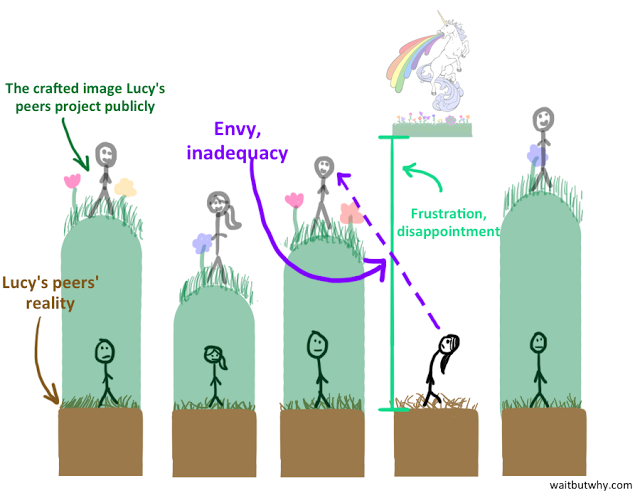
As brands try to become “more human†and connect “more authentically†with their audiences, their audiences are – under the Gen Y/Gen Z banner of authenticity – inauthentically curating and fragmenting and presenting aspects of their personalities (real and aspirational) across social networks to suit their own audiences just like a brand would.
So tl:dr brands are pretending to be human, humans are pretending to be brands, and your audience will willfully misrepresents itself while the effectiveness of your work relies on you effectively understanding them…
Okaaaay…
And when I think about this a lot – it just makes me think… if everyone is using social media inauthentically to pretend to be connecting authentically well…
THEN THE DRAGON BECOMES…
WHAT THE HELL IS THE POINT OF IT ALL?

Er…
That sounds really depressing and, well, it kind of is I guess.
But on the plus side, selective self-presentation is a tremendously human trait. It is precisely because we are human that we do this. We are nuanced, complex, contextualised, contradictory creatures. This isn’t always possible to organise on a single social network. In many respects it would be way more depressing if everyone was IRL exactly how they are in Twitter. So that’s good.
But it does mean that it is hugely hard to understand who your audience is and how they really behave from the limited and out-of-context cues they give you from any particular social channel. So for example, on Facebook they might like posts from friends about a subject they’re not interested in to support the friend, but a bot might think it’s interested in the subject.
Or on Instagram they might present or engage with almost entirely fictitiousness lifestyle that doesn’t reflect anything like they would really buy or do in real life.

It’s really hard to understand who your audience really is from social data alone, especially not-joined-up data across loads of channels. How do you have impact for your business?
My response is thus: behavioural targeting.

“Consumers don’t think how they feel. They don’t say what they think and they don’t do what they say” – y’know who said that?
Who?
David Ogilvy.

REDEMPTION!
Sure. That enables you to maximise your chances of them engaging with you on that platform. But if it’s not who they really are, how do you know it’s going to have a tangible real world impact on their behaviour beyond that channel? Can you know?

I know you think I’m being overtly depressing but actually I’m really pumped about my existential crisis and how we slay this dragon – what is the point? This point is way better.

Hashtags and the like are relatively frivolous uses of the social strategists’ time compared to this. It’s not just about understanding what makes people engage on each channel, but their motivations behind doing so and how these all joins up as part of the wider system of engagement with the brand.
That way, not only are we making sure that our social media efforts actually reach people, but that they reach the right people in the right way that actually contributes to our overall business goals rather than some arbitrary social metrics.
And and and by focussing on the audience in this way extracts all sorts of insights and intelligence that feeds into other systems – marketing and non-marketing – to make social media invaluable and integral to a business rather than the bit of glitter you rub on at the end.
Anyway, the point. The point is that businesses need social strategists to help fathom all this out before spending tonnes on a pointless campaign. Social strategists just need to fight for the people behind the facades.
Well I think we can agree on that.
All of this leads up to one major thing about our industry.

And conveniently, provocative statement number five.

Ready? [Both] OK!
And this is huge…

Existential crises, hashtag death, brandwagons… all of it! AWFUL!
And for a huge provocative statement you need an equally huge dragon.
I got this.

That is a big dragon / Pokemon.
It is. He’s there to represent this huge ‘BUT’ and that but is:

There are, as the great Ian Dury once said, Reasons to be Cheerful. We have a job on the BLEEDING EDGE OF MARKETING but what people forget about THE BLEEDING EDGE is that it’s BLEEDING; people are CUTTING THEMSELVES and getting hurt.
Whether it’s by accident or by intent from another or even if it’s just brand-driven self-harm (put that in your report to HR next time you’re doing a 360 review), it’s painful up here for us.
We’re still relatively at the beginning of understanding social media and what it can mean for businesses so, bleeding aside, there’s a lot to be inspired by. Who cares if you don’t have a hashtag if the advocacy of your customers is leading the conversation about your brand? Or if you fail to land your perfect fathers’ day post when your understanding of social behaviour is helping to redefine how your business manages customer relations?
Social may come with existential problems, dragons, and more often a not a seat at the kids’ table in meetings – but everyone in this room can be a part of changing that and redefining the industry for the the future.
It’s hugely exciting – for all of us.

And the key part of what Rebecca just said is ‘us’ – we’re in this together. And, for many of us, we’re creating and subsequently laying the foundation for future years of marketing and advertising wonders to come.
—-
[CLOSING STATEMENT. DISCUSS. Straight up mic drop? Oh yeah and is this a bit data light? Um… Maybe we should just end with an image of Judd Nelson punching the air like he does at the end of The Breakfast club? Sold.]
—

[Both] Thank you! Thank you!
_________
And that, was that.
Big love to Rebecca for being awesome and huge thanks to the support teams at Ogilvy Group UK, Brandwatch, Social Media Week London, and The National Gallery that made it all possible.
Full slides available for viewing/stealing over on Slideshare.
Full video of the presentation available for viewing on YouTube.






 whatleydude.com