About those velvet ropes

A post about Google Wave.

Back at the turn of the year, Peter Kim launched his ‘social media predictions for 2009‘. The paper, downloadable in PDF format, featured forward thinking insights from such social web luminaries as Jason Falls, Charlene Li and one of my favourite players in this space, Chris Brogan.

The predictions themselves make for interesting reading and I would (even now), recommend going back and taking a look if you have the opportunity. To cut to the chase though, it was the thoughts from Mr Brogan that stood out the most for me, mainly around his notion of the ‘velvet-rope social network’.

“I believe we’ll have more focused velvet-rope social networks in 2009 where the tools and the goals match verticals instead of the general commons of Facebook.”

Nicely put. At the time I remember agreeing with the idea, but I wasn’t entirely sure about the execution. Chris himself has returned to the subject a number of times on his own blog (often with examples). However, the reason this particular thought came back to me recently was in large part, thanks to Google Wave.

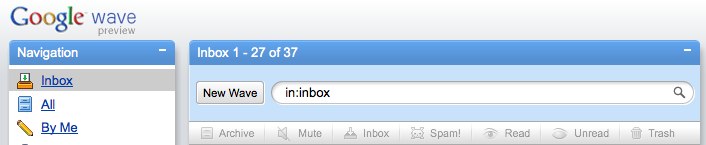
Google Wave is currently in private beta and the invites only started pouring out into the web just under a fortnight ago. With them came the promise of a new dawn in co-working, a new way of true collaboration on a global scale…  A brand new vision of the future.

Except that so far, based on at least 99% of my own experiences at least, no one has found any real use for it.

Well that is until I realised exactly what it is.

Ready?

Google Wave is, to my mind at least, one of Brogan’s new velvet roped social networks.

You open your Wave (this is your network) and invite in whoever you like to join you (as long as they are on Wave). This is, of course absolutely by invitation only. One inside you can chat, share and exchange.. basically do anything you would do normally just within the comfort of the Wave.

As Brogan said: “…the tools and the goals match verticals…”

But there’s more.

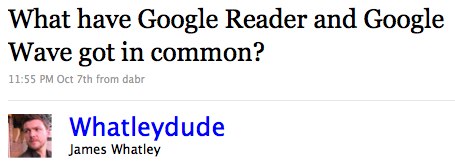
The answer? They’re both velvet-rope social networks. Why? Allow me to explain.

Not soon after I started thinking about Google Wave, I realised that another service from the big G shares the same commonalities as the velvet-rope social network: Google Reader.

Google Reader is not too dissimilar. The sharing functionality ‘baked in’ to the UI of the RSS service allows me to one-click push the stories that I’m reading out to my buddies on Google Talk (Google’s Instant Messenger service, aka ‘GTalk’). These stories then appear in my contact’s own Greader – sometimes with an added note from me – and that, is my choice.

I like sharing. I also like, occasionally picking and choosing with whom I share.

Is this the way forward?

Maybe. The point is, Google Reader is cool. I like it. I like sharing stories with my friends and I like them sharing with me. It’s closed (to a point) and I know who I’m sharing with.

Google Wave, while being no replacement for email or IM, is actually really quite useful for actually doing some work. Of the 36 ‘waves’ I have going on at the moment; one is for a specific project, a handful of massive group chats – the IM equivalent of an MMORPG (eesh), – and the rest are along the lines of ‘Is this thing on?’, ‘testing’ and my own favourite, ‘is this actually the future?’

It’s closed, for now. If you have an invite, find the people you want to work with and start a new collaborative project.

Treat it right, and you’ll yield results.
Don’t, and you’ll never see the benefit.

Thanks for stopping by.
-

Additional reading: “What problems does Google Wave solve?” (via Renate Nyborg)

13 Comments »

Seven, Eight and Nine

“It’s good to talk”

As promised in my last post, this next one is a bit of a biggie. Sitting comfortably?
Then I’ll begin…

Towards the end of last year, around the start of December in fact, I found myself having a conversation with fellow Mobile Industry Review contributor, Jonathan Jensen. He and I were discussing that as we move into 2009, brands should be placing a certain level of importance on engaging with their consumers on an increasingly more conversational level.
The exact words that struck such a chord with Jonathan were as follows:

’2007: Content was King. 2008: Context is King. In 2009? Conversation will be King.’

At this point however, I had to dash off to do a presentation for SpinVox and never got the chance to elaborate on that thought any further.

What I mean is; back in the ‘ring tone & wallpaper’ days of 2005-7 (does anyone below the age of 16 actually use those services anymore?), everywhere you went the mystic phrase was uttered; ‘content is king’

The content in this instance is the aforementioned downloadable premium additions to your handset. During my job at Mobizines (and subsequently Mippin), we were still seeing presentation after presentation and report after report, all supporting (or at least purporting to) this concept – as late as this time last year in fact.

And we lapped it up.

2007 came and went, and ‘sharing’ was set to be the theme for 2008 (thus was my prediction anyway) and you could argue that this was proven to be correct in a number of ways.

In the future, people will look back and say that Facebook was instrumental in introducing Social Media to the masses. It unified communications on a consumer level and gradually allowed people to begin sharing.

Of course, the ‘Content is King’ mantra did not just disappear with the twilight of the year. The legacy lived on, rearing its ugly head once again, this time in the form of Facebook Applications. With only a few exceptions, this first swathe of applications; including Werewolves, Ninjas, Sheep Throwing and more, were soon replaced with some contextual goodness.

The adverts soon followed suit; “Your friend ‘x’ likes this, so you will like it too…”

It’s hardly a trusted referral from a non-branded, independent entity, but it’s not far off.

We’ll come back to this point later as, before we look at trusted referrals, we need to return to content for a moment – and how that lineage spreads into Social Media.

Facebook for example, gives you contextual content from your friends. If you give any content just a smidgen of context, suddenly you’ll find you have the potential for engagement. Facebook, by turning content over to its users, allowed context to become king – almost overnight.

Context gives content meaning, and is at the centre of any Location Based Service actually ever becoming successful. Context also adds to the ambient awareness that Facebook has brought upon us all. Knowing where my friends are and what they are doing is not only easy to implement, but also fantastically simple to engage with. Comment on this, write on that, post it here – Facebook makes it so easy. Some people choose to have a constant stream of ‘noise’ flowing through them at all times, but it’s the content from your friends that is important. That is the context.

As I said in Helsinki;

“YOU are the stream, everything else is just the channel you use to publish your content…”

So that’s the consumers sorted. What about advertising?
For that, I’m going to use another quote;

“A trusted referral from a non-branded independent entity is more powerful than any amount of advertising, marketing or PR.”

- Blake Chandlee, MD Facebook Europe.

For me, this can be simply illustrated as follows: You and I are in a pub, posters surround us for Beer X, but everyone around us is drinking Beer Y.
I ask you which one you’d prefer and you say; “I’ll have what you’re having”.

When you use the same example, but add in the context of Facebook, you find that it becomes;
“Your friend likes this, so you should too.”

Alas, the latter is missing context. The pub example outlined above works because both you and I are there together, and we’re there to drink together, (two words: social objects).

The addition of an advertiser – in this case on Facebook – does not work, as there is no human context involved. It has attempted to do what I like to call ‘content wrapping’ – making an advert that has no relevance to me appear meaningful.

There is a massive difference between “I’ve done this, so you must do it too” and “I’ve done this, I loved it and here’s why you’d love it too”. It is the equivalent of me talking to you as an individual, instead of an advertiser using my profile picture to endorse its brand.

You get my meaning…

In 2008, people and brands began to realise that without context, content is rendered meaningless. Now in 2009, the tide is turning and advertisers are beginning to understand that old school games of ‘scattergun marketing’ just don’t work anymore.

This is nothing new, nor is it by any stretch of the imagination, rocket science. I’ve talked about this before numerous times. However, to give this piece context (see – it is important), I need to re-iterate a couple of things.

In 2008 – the year of sharing – context was most definitely king. Any person’s homepage on Facebook (that most people look at daily) was, and still is, very smart. It displays interesting content created by people you know (which immediately provides context), which was specifically created for you.
If that’s not targeted advertising, I don’t know what is.

Funnily, you know what else it is?

SOCIAL MEDIA

But enough of that. Let’s look forward. To 2009. To the year of CONVERSATION.

At this point it should be noted that these opinions are my own and are based on my personal experiences & knowledge of this particular space, in this particular part of the world.
In other markets, I am well aware that content is still reigning king and that context is quietly plotting its imminent downfall.

In the same way traditional marketing and advertising methods are being scrapped in favour of more intelligent niche or hyper-targeted practices, in this coming year brands will realise the benefit of engaging with their consumer on a more conversational level

Don’t get me wrong, some are doing it already, there are MANY forward-thinking brands out there doing just that.

Last year, when I wrote about being human, I talked about how the guys that will do well in this coming year will the ones that want to have genuine conversations with their consumers.

And I stand by it.

15 Comments »

MIR: Dump S60 on your N95 and install the Facebook OS instead?

facebook

Foreword by Ewan Macloed: Maybe it’s the 24 hour sound of money being well and truly spunked up the wall as you walk through the casinos or the plastic nature of Las Vegas that gets to you after one or two days — whatever the catalyst, James Whatley has found himself undergoing several epiphanies this week, most notably when it comes to S60, Facebook and phone user interfaces. Hit it, James…

- – -

Before you all call “April Fool”, this idea came around when I was invited along by Debi Jones of Mobile Jones to attend a roundtable discussion hosted by Airwide and MobileMessaging2.com entitled:

Web 2.0 comes to Handsets – New Issues and Upside for Monetizing the Mobile Web

It started with a brief overview from Steve Bratt, CEO of the W3C about Web 2.0 and the similarities with the Mobile industry etc… And then we broke out into four separate groups to each discuss particular questions.

Our table had the not so easy task of answering the following:

“What are the three capabilities consumers will want in the future and what can the mobile industry do to help enable this?”

So, aside from the obvious “Consumers have NO IDEA what they want!” rant I could’ve launched into, I was sitting there with a few folk chucking around such themes as personalized UI, location-based services and, my personal favourite, passive contextual awareness, (I’ll come back to this one at a later date).

Chatting away, sharing ideas, brain working overload… I had an epiphany:

Scrap S60, give me facebook!’

The people at the table looked at me a little dumbfounded and I went onto explain it further…

“Rip out the standard UI in this handset (waving N95) put in facebook!”

The comments came thick and fast:

“Well, I like MySpace. Can’t I have a MySpace phone?”

“Didn’t Helio do that already?”

“Yeah. But you customize the UI couldn’t you? Give users that choice…”

“Ok. Give users the choice to customize their UI…”

“Blah blah blah…”

And that was cool and ok, it answered one of the three things we had to find and stuff… However, I think this is something that bears further thought.

What is Facebook?

By its own definition it is a Social Tool.

(Not a Social Network – You and your friends are the Network, not facebook – remember that one kids).

What is a mobile phone?

Also a Social Tool.

So my question is this: Why not converge the two?

I’ve spoken about facebook in the past and how the users can be segmented in different ways etc. But fundamentally, at the most basic level, facebook is when you think about it an extremely active contacts/address book, right?

Right.

Pour that into a handset and what do you get?

I’ll show you:

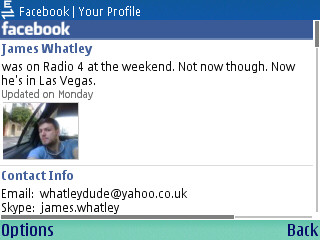
Your Contacts? Sync’d with facebook Friends.
But not only do I get numbers I also get pictures, updates, status etc.

Your Calendar? Sync’d with facebook Events.
But you get more detail, who’s coming etc (all linked across the different apps etc)

Your Games? Scrabulous anyone?!

What about SMS/Email/MMS? You’ve all sent a facebook message before right?

Your Camera? No change here. Oh, aside from photos being stored to your facebook gallery.

And Fun apps? If you read this blog I’m going to assume you’ve installed an app onto your phone before. You may well have even installed an app on your facebook too… see the link?

Don’t forget the Internet? Ahh… Here’s the killer see.

Facebook currently has no internet per se. No search. No Google box etc… That would be your link off and out of the facebook garden as it were. But hey, you never know with fb – they may well have Search on their roadmap.

Thinking about mobile search, searching the handset, like the current desktop search on the N95 or ‘Finder’ on any MacBook, would be like facebook!

Searching for “mobile geeks” and i’d be shown the event, the group and also any and all of the contacts in my address book that are part of said party.

What about my favourite app, Jaiku? Build it in.

Status updates on facebook? The mini-feed? That becomes your life-stream right there.

It could work.

Think about it.

The number one thing that people hate about changing handsets is relearning the UI: “Aww man, I’m still getting used to it” etc…

What if the UI was the same?
What if you knew how to use the UI before you took the thing out of the box because it’s the same UI that you use every day on Facebook?
And all that’s before we even begin to talk about the trusted relationship that the consumer already has with facebook as a brand…

Ok, so – taking a breath – maybe the web UI is not built to work on a phone. Maybe having a “facebook phone” would be almost as bad as Helio’s “MySpace Phone”.

But why not have the facebook engine running underneath a very basic UI. With all the information embedded and layered underneath each contact or event or picture, creating context sensitive content…Makes sense huh?

I guess what I’m getting at is the ideas and principles behind the semantic web, on your mobile.

It doesn’t have to be facebook. It could be anything. Just join the dots.

What do you think?

9 Comments »